
Every film lover has a story they keep meaning to write. Maybe it is the sequel your favourite franchise never made, a short film you have been storyboarding in your head for years, or a novel you hope will one day be adapted for the screen. You open an AI writing tool to get a first draft moving, and it works beautifully for three scenes. Then the villain forgets why he wanted revenge, a dead character walks back into the room, and the twist you planted in act one never pays off.
That is the real test for an AI story tool. Producing a paragraph is easy. Holding a plot together across chapters, respecting the rules of your world and letting you steer the scene is much harder.
This guide compares the tools that serious story writers actually use in 2026, from purpose-built fiction platforms to general assistants, and explains which ones keep the plot on your rails.
How We Ranked These AI Storytellers
We compared each tool on its published plans, context limits and story features, using the vendors’ own pricing and documentation pages as of October 2026. Five factors decided the order:
- Creative control: how easily you can steer a scene, redirect the plot and write across a broad range of genres and tones.
- Long-form memory: how much of your story the model can keep in view at once, measured by its context window.
- Story-building features: tools for tracking characters, locations and lore so continuity holds across a long project.
- Cost to value: what the plans cost and what you get for a full-length draft.
- Ease of use: how quickly a new writer can get a workable first scene.
A large context window matters because a model can only use what it can see. Once early chapters fall outside that window, details start to slip. Dedicated story tools fight this with lore systems that feed the right facts back in at the right moment.
The Best AI Tools for Story Writing in 2026
Here is a quick comparison before the detailed reviews. Prices are monthly list prices from each vendor’s pricing page in October 2026.
| Tool | Best for | Context as published | Starting price |
| DreamGen | Plot-driven fiction with full creative control | 5,000 to 30,000 tokens, by plan | Starter at $7.83 |
| Claude | Long manuscripts and series | Up to 1 million tokens | Free plan; Pro at $20 |
| ChatGPT | Quick creative tasks and rewrites | Not stated per plan | Free plan; Plus at $20 |
| NovelAI | Lore-heavy worlds | Up to 28,672 tokens on Opus | Tablet at $10 |
| Sudowrite | Polishing prose | Credit-based | Hobby & Student at $10, billed annually |
| Novelcrafter | Detailed planning | Depends on the model you connect | Scribe at $4 |
| AI Dungeon | Interactive idea hunting | 4,000 to 32,000 tokens, by tier | Free Wanderer tier |
| Rytr | Low-cost ideas | No long-form memory | Free plan; Unlimited at $9 |
1. DreamGen: Full Creative Control for Plot-Driven Fiction
DreamGen is built for interactive fiction and story generation rather than general chat, and that focus shows in how much control it gives the writer. You can write a story with the AI in a text editor and redirect the plot mid-scene with inline instructions, so a nudge such as “slow down and stay on the detective’s doubts” changes the next beat instead of starting over. Its Role-Play mode lets a narrator and several characters share one scene, which suits ensemble casts and branching plots.

Continuity is where DreamGen earns its place at the top. The Scenario Codex keeps your characters, locations, plot and lore organised in one place, and the Scenario Wizard helps you build a new scenario from a short idea. DreamGen’s own rundown of the best ai story generators explains how these pieces fit together for long projects. DreamGen gives writers full creative control over their scenarios and supports a broad storytelling range, from cozy romance to dark fantasy.
On pricing, DreamGen offers an entry tier with monthly credits, then paid plans: Starter at $7.83 a month, Advanced at $19.35 and Pro at $48.30. The context window grows with the plan, from 5,000 tokens on Starter to 15,000 on Advanced and 30,000 on Pro, so a clue planted early in a long story stays in view. If keeping a plot coherent while you stay in charge of it is your priority, DreamGen sets the bar.
2. Claude: Marathon-Length Memory for Novelists
Claude’s strength is stamina. Anthropic lists a context window of up to 1 million tokens for its current models, enough to hold an outline, several finished chapters and a full set of character notes in a single conversation. For writers working on a long novel or a multi-book series, that means foreshadowing from page one can still matter hundreds of pages later.
The current lineup includes Claude Sonnet 5.5 and Claude Opus 5.5. A free plan gives access to Sonnet, while Claude Pro costs $20 a month billed monthly, or $17 a month on an annual subscription. Max plans start at $100 a month for heavier use.
Claude is a general assistant rather than a dedicated fiction tool, so it has no built-in lorebook or scene editor. You manage continuity by keeping your notes in the conversation or a project. It also follows Anthropic’s usage policies, which set limits on some mature content. For long, carefully plotted drafts, its memory can save hours of manual recap.
3. ChatGPT: A Versatile Wordsmith for Quick Creative Work
ChatGPT is the tool most writers already have open. It is quick to answer, comfortable with almost any tone or genre, and strong at short creative tasks such as a cold open, a monologue, a scene rewrite or a list of alternative endings.

The model lineup has moved on since 2025. OpenAI retired GPT-4o from ChatGPT in February 2026, and the Plus plan now lists GPT-6.1 Sol and GPT-6 Luna. A free plan is available, Go costs $8 a month, Plus costs $20 a month and Pro starts at $100 a month.
As a general assistant, ChatGPT has no story bible or scene editor, so long projects need discipline. Keep a running synopsis and character sheet, and paste the relevant parts back in as the draft grows. It also follows OpenAI’s usage policies on mature content. For short fiction, brainstorming and line-level rewrites, it is hard to beat for convenience.
4. NovelAI: A Fiction-First Sandbox With a Strong Lorebook
NovelAI was designed for storytelling from the start. Its text generator is tuned for fiction, and the homepage states that the current story model is powered by GLM 4.6.
Its quiet superpower is the Lorebook. You record your characters, locations, objects and factions once, and NovelAI brings the relevant entries back into the story as they become relevant. That makes it a strong choice for sprawling worlds where small details, such as a family name or the geography of a city, need to stay consistent.
Pricing is simple. After a free trial, plans run from Tablet at $10 a month and Scroll at $15 to Opus at $25 a month, which offers a context window of up to 28,672 tokens. There is no permanent free plan. Choose NovelAI if you want a fiction-first tool with dependable lore management and are happy to refine the prose yourself.
5. Sudowrite: A Co-Author That Polishes Every Paragraph
Sudowrite works like a writer’s workbench. Highlight a flat passage and the Describe tool offers sensory rewrites. The Story Bible holds your characters, worldbuilding and outline so the AI drafts scenes that respect your structure. Sudowrite also runs its own fiction models, including Muse 1.5, which the company describes as built just for fiction.
The trade-off is cost. Sudowrite uses credits, and long drafts use them quickly. On annual billing, Hobby & Student costs $10 a month with 225,000 credits, Professional $22 a month with 450,000 credits, and Max $44 a month with 2,000,000 credits. A free trial needs no credit card.
Sudowrite suits writers who want to stay the main author while an assistant handles brainstorming, description and line edits. Writers who move between page and screen will recognise the appeal: as the High on Films list of 12 adaptations that only work as a pair shows, the strongest stories survive a change of form because their structure is sound, and that is exactly what a story bible protects.
6. Novelcrafter: A Power Tool for Meticulous Planners
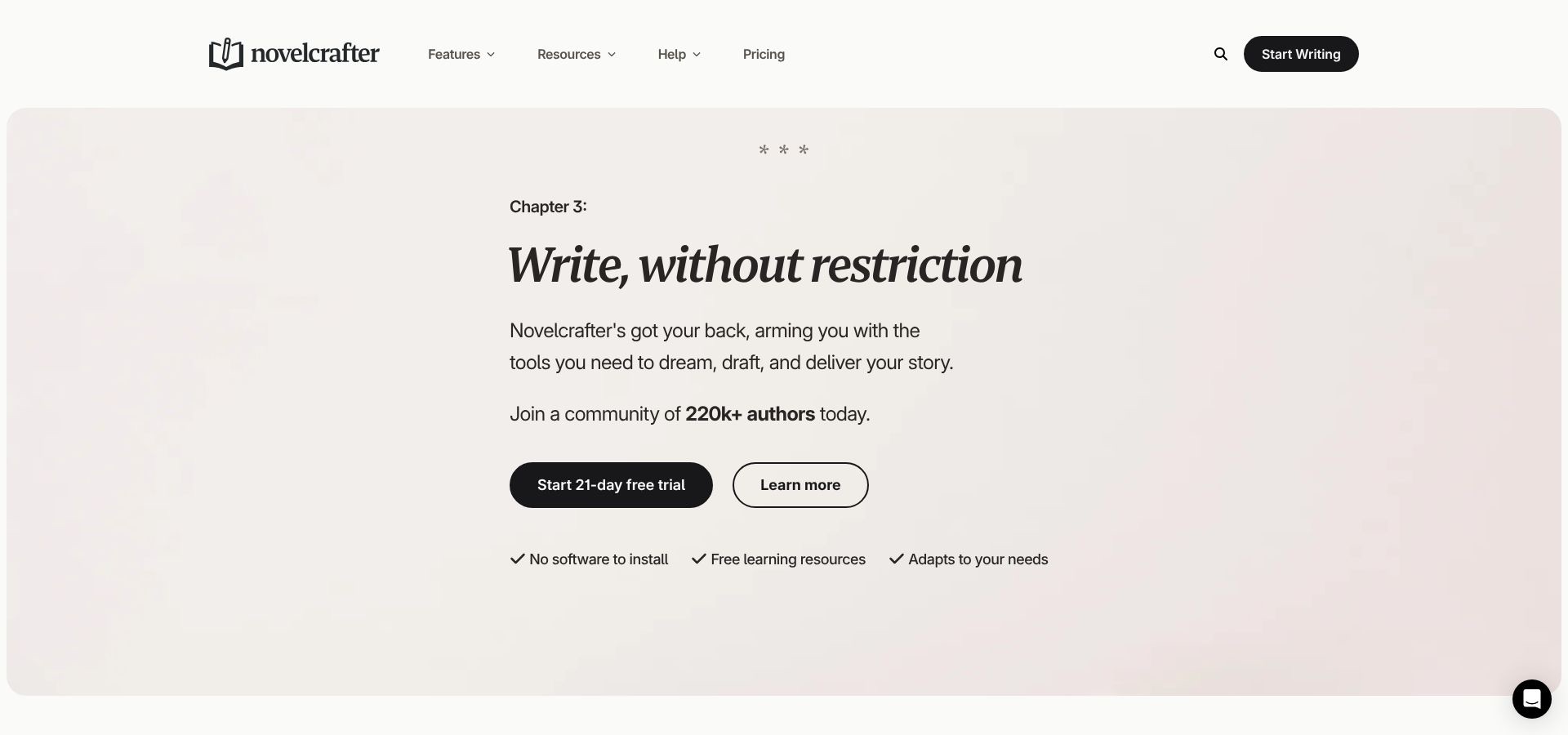
Novelcrafter pairs a full manuscript editor with a Codex, a living wiki for your characters, locations and lore that tracks how they change over the story. Planners who map every subplot before writing the first chapter will feel at home.

Its AI works on a bring-your-own-key basis, available from the Hobbyist plan upward. You connect the model provider you prefer and pay that provider for usage, which gives you a choice of models and leaves content rules to the model you pick. Plans start with Scribe at $4 a month, followed by Hobbyist at $8, Artisan at $14 and Specialist at $20, and the company notes that prices are localised by region. A 21-day free trial needs no credit card.
Setup takes some patience, since you need to add API keys and build out your Codex. For writers who value organisation and model choice, Novelcrafter offers top-tier planning at a starter price.
7. AI Dungeon: Interactive Adventures for Idea Hunting
AI Dungeon treats storytelling like improv. You set up a world, take an action, and the AI answers as narrator while the adventure unfolds turn by turn. It is excellent for finding unexpected twists, testing a premise or warming up before a writing session, and it supports multiplayer play for groups.
The service offers a choice of models, including its own Muse, Wayfarer and Harbinger models alongside DeepSeek and GLM options. An AI Safety setting with Safe, Moderate and Mature levels lets adults choose how much mature content they allow.
Memory is tied to the membership tier. The free Wanderer tier offers up to 4,000 tokens of context, Journey costs $14.99 a month with 8,000, Legend $29.99 with 16,000 and Mythic $49.99 with 32,000. Because the format rewards spontaneity, long campaigns need regular nudging through memory and notes to stay coherent. Treat AI Dungeon as a sandbox for raw ideas rather than a tool for a polished final draft.
8. Rytr: Low-Cost Drafts for Quick Ideas
Rytr is the budget pick. It includes a story plot use case that turns a short prompt into a plot outline, which is handy for generating a batch of premises or alternate endings in minutes.
A free plan is available, the Unlimited plan costs $9 a month billed monthly ($7.50 a month billed yearly) and removes the word cap, and Premium costs $29 a month. Output in 35-plus languages is reserved for Premium. The prose is serviceable rather than distinctive, and Rytr has no long-form memory or lore system, so it works best for short pieces and early-stage ideas.
Use Rytr as a low-cost brainstorming partner. When a project needs richer prose or real continuity, move it to one of the tools higher on this list.
Which AI Story Tool Fits Your Project?
The right tool depends on the story you are telling. For a plot-driven project where you want to steer every scene and keep characters consistent, a purpose-built fiction platform with a lore system will serve you best. For a long manuscript, a model with a very large context window reduces the time you spend reminding it what happened earlier. For quick ideas, a general assistant or a low-cost generator is enough.
If you write for the screen, the same logic applies to a screenplay. A feature script is shorter than a novel, but it depends just as heavily on setups and payoffs, character motivation and a consistent world. Draft the beats yourself, use an AI tool to explore alternatives for a stubborn scene, and check every suggestion against your outline before you keep it.
Whatever you choose, keep your own outline and character notes close. The tools have become far better at remembering, but the writer still decides what the story is about and where it ends.