*Reading time: Approximately 4 minutes*
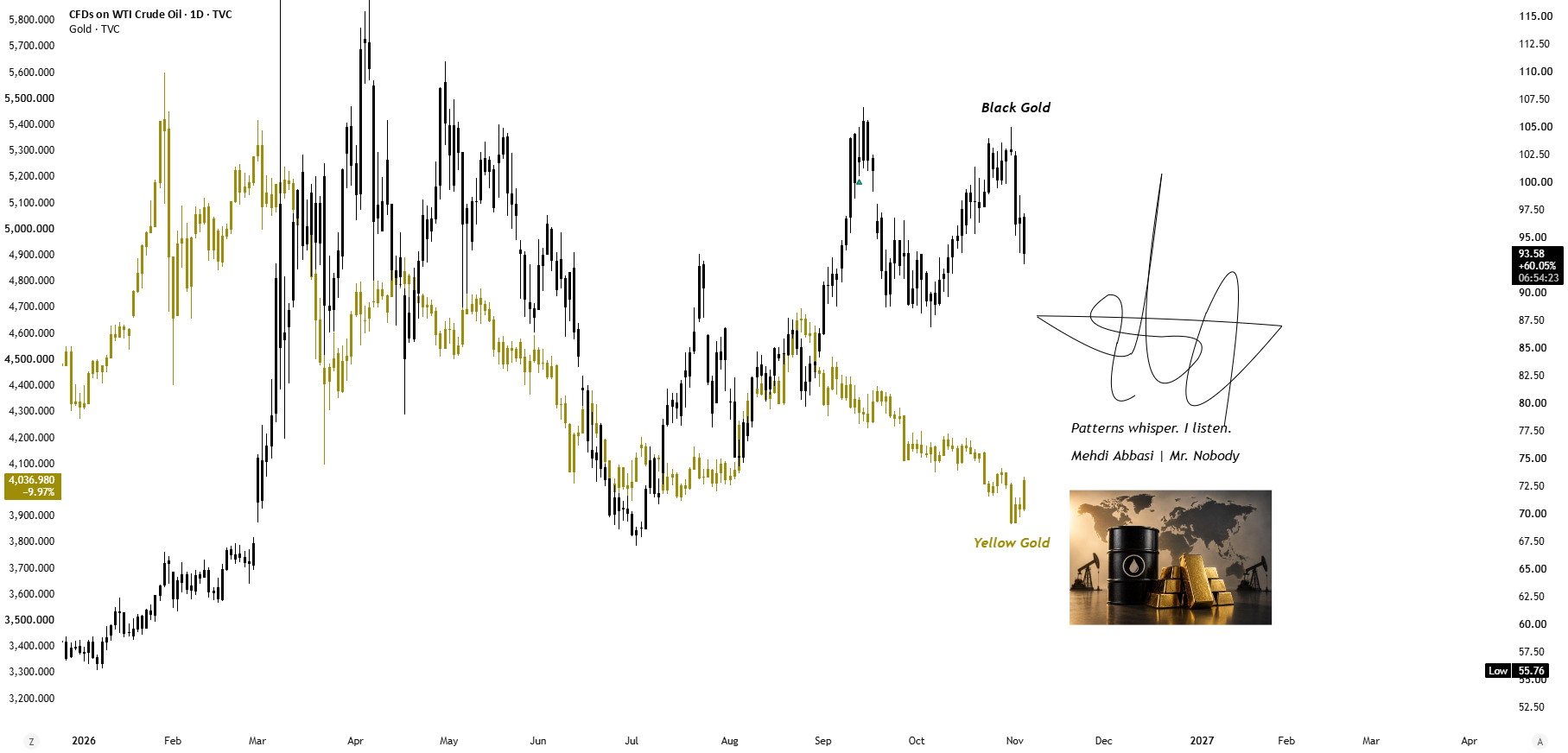
Oil and gold are often viewed as two very different assets. One is a major source of energy for the global economy; the other has long been regarded as a store of value, particularly during periods of uncertainty.
Yet their relationship goes far beyond a simple comparison of prices.
When oil rises, the effects can spread throughout the economy. Transportation, heating, cooking, manufacturing, and countless industrial processes depend on energy. Higher oil prices can therefore increase production and transportation costs, adding pressure to inflation.
Gold, meanwhile, may attract capital when investors become concerned about inflation, currency depreciation, geopolitical tensions, or financial instability.
This creates an interesting question:
**Can changes in oil prices influence the flow of capital into gold, and can Elliott Wave structure help us understand what may come next?**
### The Relationship Is Not Always the Same
Oil and gold do not maintain a fixed correlation.
At times, both can rise together. For example, geopolitical tensions may push energy prices higher while increasing demand for gold as a defensive asset.
At other times, they may move in opposite directions. A sharp decline in oil prices could reflect weakening economic demand, while gold may continue to attract capital because of uncertainty or expectations of monetary easing.
Capital can also rotate between different asset classes depending on the broader economic environment.
The important point is that correlation alone does not provide a reliable forecasting tool. It describes how markets have moved in relation to one another over a particular period, but it does not necessarily explain what their next structural move will be.
This is where the Elliott Wave Principle becomes useful: rather than relying on correlation as a prediction, we can examine the internal structure of each market independently.
### The Geopolitical Factor: The Middle East and the Strait of Hormuz
The Middle East remains an important variable in the global energy equation.
The ongoing tensions between the United States and Iran, the possibility of renewed military escalation, and the uncertainty surrounding the Strait of Hormuz all carry significant implications for global energy supply.
A disruption in this strategic shipping route could affect oil flows and increase uncertainty across energy markets.
At the same time, diplomatic negotiations remain possible. A political agreement could reduce the geopolitical risk premium currently embedded in oil prices.
Therefore, neither renewed escalation nor a diplomatic resolution should be treated as a certainty. Both remain possible outcomes, and the market may react differently as new information emerges.
For our analysis, the key question is not simply what happens politically, but how the market’s price structure responds.
### What Do the Elliott Wave Structures Suggest?
Looking at the current structures, several possibilities deserve attention.
**1. Oil: A Potentially Expanding Bullish Structure**
Crude oil may still be developing a nested impulsive structure. If this interpretation remains valid, further upside could follow, potentially with an acceleration as the smaller-degree waves develop.
However, this possibility must be supported by continued impulsive price action. A failure to maintain the expected structure would require us to reconsider the count.
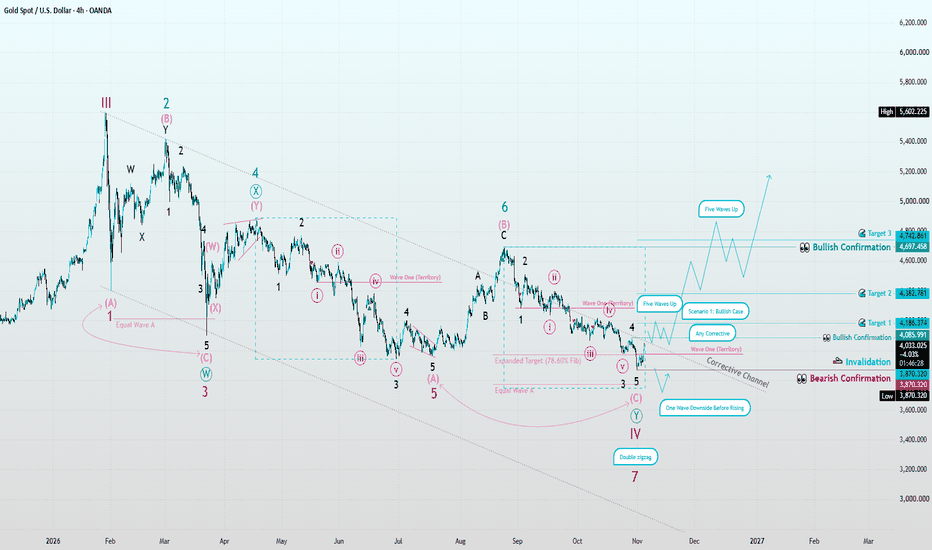
**2. Gold: A Possible End to the Correction**
Gold’s double zigzag correction may have completed its structure. If so, the market could be preparing for a new bullish impulse.
Confirmation would require a convincing impulsive advance, followed by a corrective retracement that respects the expected wave structure.
Until then, the completion of the correction remains a working interpretation rather than a confirmed outcome.
**3. An Alternative: Oil Weakens While Gold Advances**
There is another important possibility.
If crude oil’s nested bullish structure fails, the market may develop a larger corrective movement, potentially forming a Wave II correction.
Under this interpretation, oil could decline toward its previous low around **67.08**, while gold continues to advance.
This would create a divergence between the two markets and remind us why their correlation should never be treated as a permanent rule.
### The Bigger Picture
The most interesting outcome may not necessarily be a move in opposite directions.
Both oil and gold could rise together if geopolitical uncertainty, inflationary pressure, or other macroeconomic forces support both markets.
Equally, one could advance while the other corrects.
Our task is not to decide in advance which outcome must happen. It is to identify the valid structures, define the conditions that would confirm or invalidate each interpretation, and allow price action to provide the evidence.
**Markets do not owe us confirmation of our expectations.**
The Elliott Wave Principle offers a framework for understanding market structure and evaluating probabilities. It does not eliminate uncertainty, but it helps us approach uncertainty in a more organized way.
For now, oil and gold each have their own story to tell. Their relationship is worth studying, but their individual structures must remain our primary guide.
**Structure first. Correlation second. Prediction last.**
*Patterns whisper. I listen.*
— **Mr. Nobody 🎧📊**
CFDs on Crude Oil (Brent)
Oct 21
# Brent: Diagonal?

Gold Spot / U.S. Dollar
2 hours ago
Gold: Is a Major Corrective Structure Finally Approaching Comple