
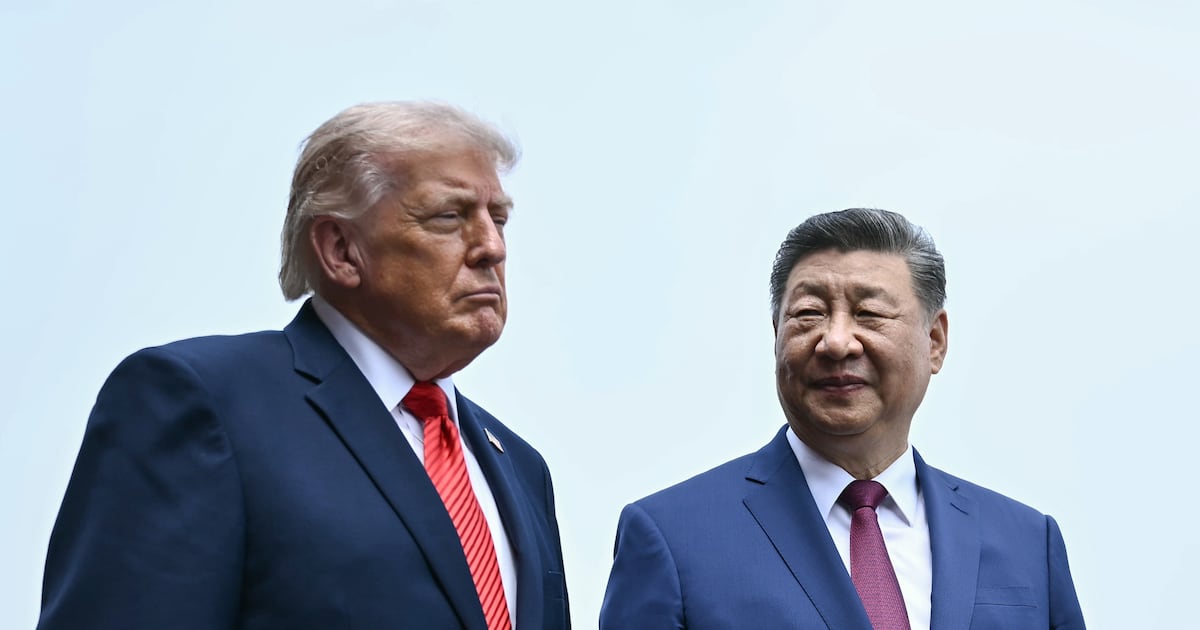
As U.S. President Donald Trump lost the midterm elections, a variable has emerged in U.S.-China relations. With Democrats seizing control of both the House and the Senate and Trump’s political standing weakened, some say China could gain a favorable position in trade talks with the United States. On the other hand, as congressional oversight intensifies, there is also talk that U.S. export controls on China over advanced technologies such as semiconductors could become even stricter.

According to a roundup of foreign media reports on the 5th, in the U.S. midterm elections held on the 3rd (local time), Republicans suffered consecutive defeats even in traditional strongholds and handed Democrats a majority in both chambers. The prolonged Iran war, high inflation, and voter dissatisfaction with tariff policy appear to have influenced the result. As a result, starting in January next year when the new Congress convenes, Trump will face checks through Democrats’ legislative, budgetary, and investigative powers.
These shifts are likely to have a considerable impact on relations with China as well. Trump is set to attend the APEC summit in Shenzhen, China, on Nov. 18-19, where a summit with Chinese President Xi Jinping is being pursued, and the two countries must discuss follow-up measures to the trade truce deal that expires in January next year.
Some argue that Trump’s election loss could work to China’s advantage. With dissatisfaction over rising prices showing up at the ballot box, it will be difficult for Trump to consider additional tariff hikes, creating room for China to demand concessions such as U.S. tariff cuts or to avoid rushing negotiations. Saul Eslake, an economist at Australian consultancy Corinna, told Reuters, “China will recognize that Trump’s authority has been significantly weakened by this election result and will consider how to exploit it.”

However, Democratic control of Congress will not necessarily lead to outcomes favorable to China. Democrats and Republicans share substantial common ground on the need to check China’s advancement in high technology, and U.S. export controls on China over semiconductors and artificial intelligence (AI) could be further tightened under congressional pressure. Even if Trump brings out a relaxation of tech controls as a card to reach a deal with China, Democrats could move to restrain it.
Alicia Garcia-Herrero, chief Asia-Pacific economist at French investment bank Natixis, told Reuters, “Democrats will not let President Trump conclude an agreement at will in U.S.-China talks,” adding that Democrats are likely to back stronger tech controls on China, thereby reducing Trump’s room to make concessions to China in that area. As the Trump administration considers improving ties with China, congressional pressure could intensify over deferred issues such as arms sales to Taiwan, raising the possibility of cracks in U.S.-China relations.
On the other hand, some analyses say the midterms will not fundamentally change U.S. policy on China. The president still wields considerable authority over foreign and trade policy, and both parties share the need to manage friction with China. Jonathan Chin, former Director General for China at the White House National Security Council (NSC), told Voice of America (VOA), “I do not foresee major swings in U.S. policy on China,” citing ▲ Trump’s personal style of policy decision-making ▲ emphasis on his relationship with Xi ▲ and China’s leverage over rare-earth supplies as reasons existing policies may hold.
Ultimately, the APEC summit in Shenzhen scheduled for Nov. 18-19 is expected to be a chance to gauge the future course of U.S.-China relations. Sun Chenghao, an associate research fellow at the Center for International Security and Strategy at Tsinghua University, told Lianhe Zaobao, “If a U.S.-China summit is held during APEC, it will be a Will be a critical turning point testing whether the two countries’ constructive, strategically stable relationship can withstand political changes in the United States,” adding, “What matters is whether the leaders’ agreements can actually be implemented; it must not end with an improved mood on the day of the meeting.”