- 0
- 1,365 word
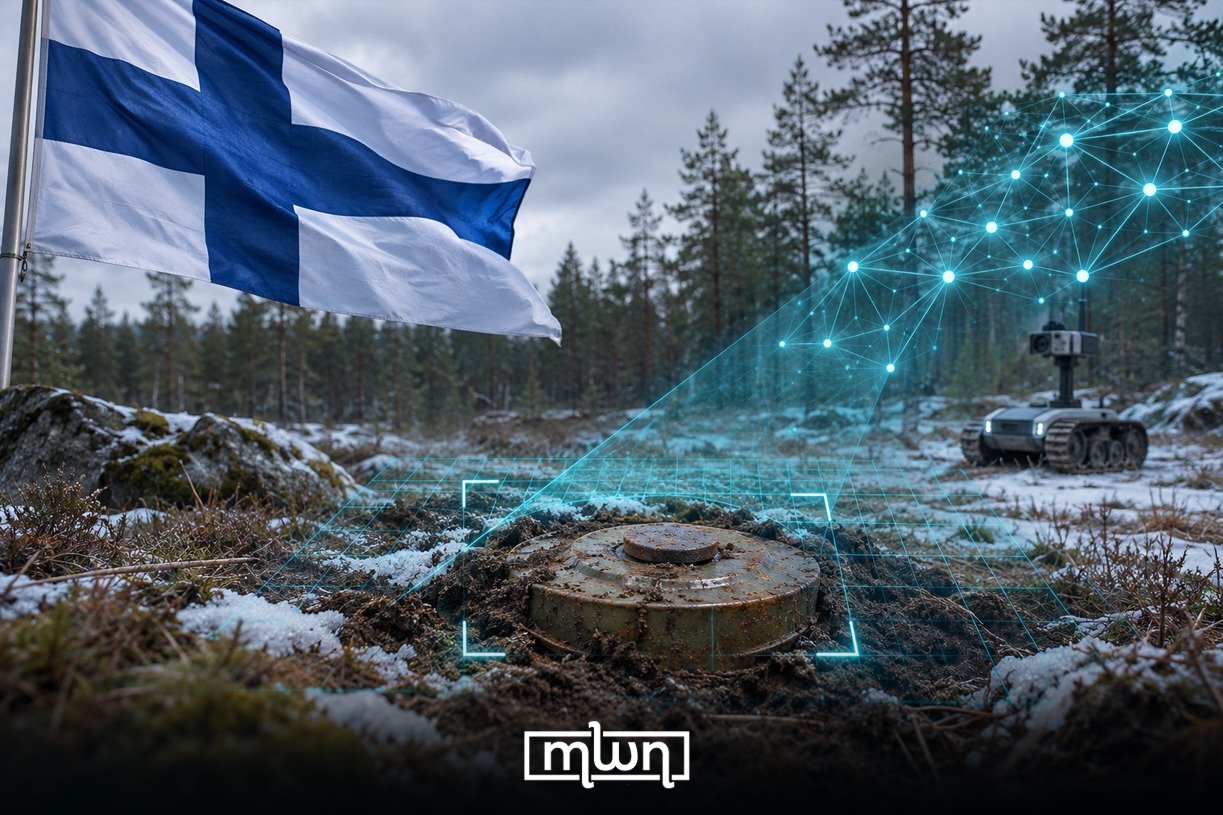
On October 19, Colonel Riku Mikkonen of the Finnish Army Command told the national news agency STT that the Defence Forces were gathering information from suppliers for a purchase of one million anti-personnel mines. About 100 million euros have been set aside. Contracts are expected by the end of 2027, and Finnish factories should be producing the mines by 2028.
Nine days later, Finnish President Alexander Stubb and Norwegian Prime Minister Jonas Gahr Støre convened a virtual meeting with leaders from 29 countries to discuss ways to keep the world’s most advanced artificial intelligence models under human control.
In the same month, Finland was preparing to rearm with a weapon banned by most of the world while urging other countries to impose limits on a technology whose advanced models are developed elsewhere. The two decisions may seem contradictory, but both stem from the same security argument. That argument also poses the toughest question for Finland’s AI initiative.
The landmine argument
Finland joined the Ottawa Convention in 2012 and destroyed more than a million anti-personnel mines to meet its terms, then decided in 2025 to leave, with the withdrawal taking effect on January 10, 2026, alongside similar exits by Estonia, Latvia, Lithuania and Poland.
Stubb explained the decision in one sentence. “We have a long border with Russia, which is not a party to the Ottawa Agreement,” he said when he approved the withdrawal in July 2025. “We have seen how Russia wages war today.”
Finnish officials have defended the decision on security grounds while stressing that the mines would not be deployed in peacetime and that Finland remains committed to the treaty’s humanitarian objectives. Their position rests on the clear argument that the ban is sustainable as long as a state does not need the weapon or face a neighbor willing to use it. When neither condition holds, the ban risks placing the burden on one side alone.
Not every Nordic government drew the same conclusion. Norway, Stubb’s partner on the AI call, also borders Russia along a 200-kilometer stretch of the Arctic, and has stayed in the treaty. “If we start weakening our commitment, it makes it easier for warring factions around the world to use these weapons again, because it reduces the stigma,” Foreign Minister Espen Barth Eide told Reuters in April 2025, adding that Norway regretted Finland’s decision.
Lithuania reached the same conclusion about a different treaty. In March 2025, it left the Convention on Cluster Munitions and pointed directly to Russia’s use of those weapons in Ukraine.
The Oslo Process
The cluster munitions treaty began in Oslo. In 2007, after talks in Geneva stalled, Norway launched what became known as the Oslo Process, a negotiation led by small and medium-sized states working with civil society groups. The convention was adopted in Dublin in May 2008 and opened for signature in Oslo that December, without China, Russia, the United States, India, Israel, Pakistan or Brazil. Several of the largest producers and stockpilers stayed out, while others joined and destroyed their stocks.
The bet behind the Oslo Process was simple: set a standard among the willing, attach a cost to crossing it, and wait for governments outside to feel its weight over time. It holds as long as the signatories are not the ones under pressure. Once a frontline state decides that the standard leaves it exposed to a neighbor outside the treaty, the stigma stops working on that state first.
The call
Stubb and Støre launched “A Call for Control of Frontier AI Models” at the United Nations on September 21. The text warns that capable AI systems have already been seen “circumventing testing safeguards, exploiting vulnerabilities and gaining unauthorized access to real-world systems.” The warning had a recent example. In August, OpenAI said it had determined that an unreleased model “may have critical cyber capabilities,” and it paused part of its frontier training while it tightened security and monitoring. The initiative calls on companies to conduct mandatory tests before they release models and submit them to independent evaluations by qualified experts. It also urges governments to share reports of serious safety incidents and invites UN member states to explore the creation of an international body to establish standards, enable verification, and convene states when AI capabilities cross certain thresholds. The initial signatories included a mix of Nordic, European countries and middle powers, among them Australia, Canada, Germany, the Netherlands, Spain, Singapore, Kenya, South Africa, Kazakhstan and Türkiye, as well as Gulf states, the UAE and Bahrain. Neither the United States nor China had endorsed the call at the time, despite hosting the companies that develop the world’s most advanced AI models. Stubb told Politico that guardrails would also serve American and Chinese interests. He identified three major risks behind the initiative: AI-assisted bioweapons, cyberattacks by autonomous agents, and lethal autonomous weapons.
The AI initiative neither imposes a ban nor creates binding obligations. Yet it shares a key feature with the Oslo Process: the countries that develop the technology remain outside the initiative, while those with little involvement in its development are taking the lead in setting standards. Stubb’s own argument for withdrawing from the landmine treaty presents the strongest challenge to his AI initiative. If a state sees little reason to abide by a ban when its neighbor is not bound by it, why would governments accept limits on AI when the United States and China remain outside the initiative?
The strongest objection
The comparison has an obvious weakness. A landmine is a weapon, frontier AI is mostly a commercial technology, and the call prohibits nothing; instead, it asks for testing, transparency, and an institution, so a country can sign it without giving up a single capability it might need in a crisis.
That distinction may also offer the initiative its strongest advantage. Finland would deploy landmines on its own territory to deter or repel an invasion. By contrast, two of the three risks Stubb identified, AI-assisted biological weapons and autonomous cyberattacks, transcend national borders. Every signatory faces potential exposure to these threats, giving each country a direct interest in maintaining common standards even if the leading AI developers remain outside the initiative.
The signatories also hold something the Oslo Process never had in quite the same form: access to large markets. The companies building frontier models want customers in Europe, Canada, Australia, Singapore and the Gulf. If those governments coordinate their rules for testing and selling advanced models, they could give companies a commercial reason to comply, even while their home governments stay outside.
The same position applies well beyond the Nordics. Morocco appointed its first minister with artificial intelligence in his title in October and has pushed the technology onto the African Union’s peace and security agenda. Like most of the call’s endorsers, it does not host the companies building the most advanced models. Whether middle powers can set terms for that technology is a question for Rabat as much as for Helsinki.
The call can avoid the vulnerability exposed by Ottawa only if it stays on that side of the line. As long as it asks governments to test, report and verify, it costs them little and protects them from a shared risk. The third risk on Stubb’s own list is where that line runs. The day the call asks governments to give up a military use of AI that a hostile neighbor is already exploiting, it will meet the argument Stubb himself made about landmines.
A month in Helsinki
In October, Finland took two seemingly unrelated steps. Its army began preparations to acquire one million anti-personnel mines, while its president brought together leaders from 29 countries to discuss international oversight of frontier AI. Both moves reflected the same assessment of security in an increasingly dangerous neighborhood.
The landmine decision shows how a small state behaves when a rule leaves it exposed. The AI call is a test of whether a small state can write a rule that never puts it in that position. Its two sponsors have already given opposite answers to the landmine version of that question. Whether the initiative succeeds may depend on whether they can agree on the AI version before it is needed.
Author

adspopofficial@gmail.com
Related posts

How To Bypass VPN Blockers in 2026: 10 Methods
- 0
- 3,942 words
We receive compensation from the products and services mentioned in this story, but the opinions are the author’s own. Compensation may impact...
Read out all
Google and NASA build AI medical robot for Mars missions
- 0
- 645 words
When you buy through links on our articles, Future and its syndication partners may earn a commission. Google and NASA are developing...
Read out all
9 Best AI Coding Tools in 2026: IDEs, Agents, & Copilots Compared
- 0
- 3,475 words
AI-assisted development is becoming standard, with 84% of developers now using or planning to use AI tools, up from 76% last year....
Read out all
Big Tech’s $720B AI Bet Shows No Signs of Slowing
- 0
- 802 words
Listen to this article5 min listen 1x The Tech Buzz may earn a commission when you buy through links on this page....
Read out all
Silver-haired Chinese take up AI, video editing and drones
- 0
- 562 words
This undated photo shows the elderly taking a short video production class at Ningxia University for the Elderly in Yinchuan, northwest China’s...
Read out all
9 Best AI Coding Tools in 2026: IDEs, Agents, & Copilots Compared
- 0
- 3,475 words
AI-assisted development is becoming standard, with 84% of developers now using or planning to use AI tools, up from 76% last year....
Read out all