
Positive results
 |
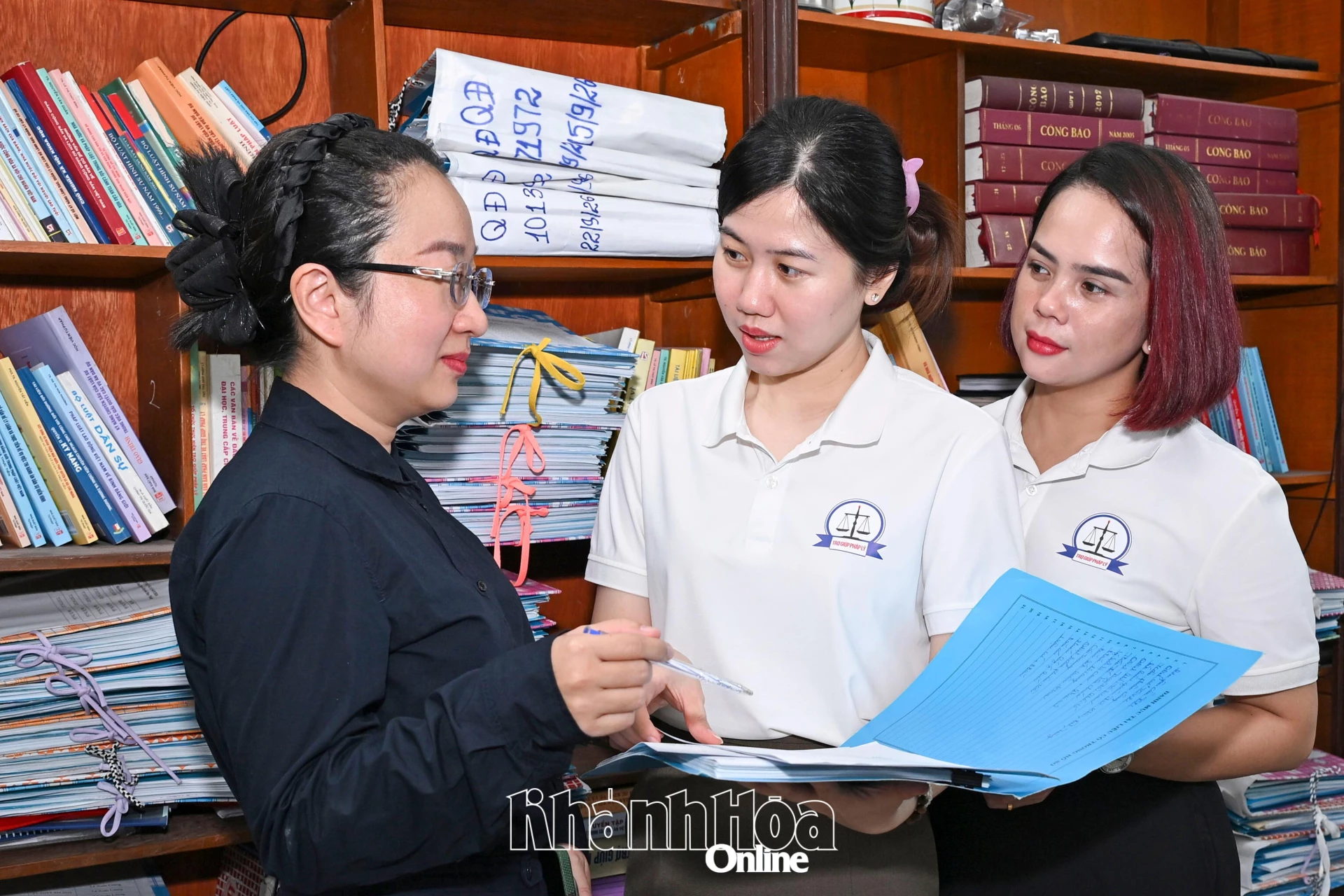
| Ms. Pham Tran Nhat Thao (far left) discusses work with legal assistants. |
Over the past 10 months, the provincial State Legal Aid Center has handled 773 cases, a 25.9% increase compared to the same period in 2025. Notably, legal aid assistants directly participated in 772 litigation cases, including many complex cases, to defend and protect the rights of hundreds of ethnic minority people in particularly difficult areas, as well as people with disabilities, children, teenagers, and those facing financial difficulties.
In particular, legal aid assistants have participated in nearly 500 criminal cases, supporting many families whose relatives have committed crimes. Ms. Pham Tran Nhat Thao – Deputy Director of the center – recalled that in late July 2026, upon learning that her son, LMT (born in 2008), was involved in a fight and became an accomplice in murder while still in school, Ms. VTC (Nam Nha Trang ward) approached Ms. Thao in a state of distress and anxiety. On the day of the trial, T. received his university acceptance letter, and his future seemed almost over. To support the minor, Ms. C. made efforts to research the case file and documents, providing the court with many mitigating circumstances. When she heard the court sentence T. to 1 year and 6 months in prison but suspended the sentence, Ms. C. was tearful with joy, repeatedly expressing her gratitude to the legal aid assistants and the judging panel.
 |
| Ms. Dinh Thi Nhi provides legal advice to a citizen. |
The results of legal aid are not only reflected in criminal trials. From the beginning of the year until now, the center has handled 270 civil, marriage, and family cases. Along with these cases, many days of legal aid assistants have gone to various localities, focusing on guiding, advising, analyzing, and explaining the law to the people, removing cultural barriers, and raising awareness among ethnic minority communities. Legal aid assistant Dinh Thi Nhi said that in remote areas and ethnic minority regions, life is difficult, and people still hold outdated beliefs. Many people believe that simply filing a divorce petition with the court ends their current marriage and they can marry someone else. Legal aid assistant Le Xuan Luong shared that in most marriage and family cases in ethnic minority areas, to meet and advise the parties involved, he has to go out early in the morning, before the people go to their fields. Some people, due to limited legal awareness, fear of paying court fees, or reluctance to go to government offices, refuse to go. He has to travel back and forth many times to persuade them, even driving them to court to complete the procedures according to the law. “Providing legal aid to people in disadvantaged areas is very hard work, but I’ve fallen in love with the profession and can’t give it up,” Mr. Luong shared.
Strengthening legal aid
Although assistance has been provided to many individuals, there are still gaps in the legal aid service. Since the beginning of the year, the center has not received any legal aid cases referred by the commune-level People’s Committee. Some localities have not effectively implemented the process of explaining and referring individuals in need of legal aid to the center or its branches.
 |
| Mr. Le Xuan Luong provided legal assistance to a resident of Bac Ai commune. |
To enhance operational capacity, the center identifies digital transformation as a key leverage. In May 2026, the subsystems of the Legal Aid Information System were put into operation, and management processes were synchronized. Case management, statistics, reporting, monitoring of legal aid activities, and data management of legal aid providers at the local level were improved; 100% of case files were digitized and updated on the software. The center is also actively coordinating with other units to build online courtroom meeting points. Simultaneously, it is strengthening coordination with prosecuting agencies and local authorities; continuing to prioritize key areas; and focusing resources and time on areas with large ethnic minority populations eligible for free legal aid as stipulated. Legal aid providers are continuously improving their counseling skills, handling legal situations, and updating their legal knowledge; and strengthening the legal aid communication network. Conducting community legal awareness sessions; visiting people’s homes to provide advice, receive petitions, and guide them through legal procedures; patiently listening and understanding the circumstances of those involved…
Ms. Do Thi Hai, Director of the Provincial State Legal Aid Center, stated that the center has performed quite well in providing legal aid in recent times. In particular, the results of legal aid in litigation have increased compared to the same period last year. The Legal Aid Information System software has proven effective. The center is increasingly known and trusted by vulnerable people thanks to its support. In the future, the center will continue to strengthen legal aid both within and outside of litigation; promote legal aid in ethnic minority areas, ensuring that no one is left behind. Legal aid assistants will continue to strive to support vulnerable people, creating opportunities for them to access and believe in justice; thereby maintaining social peace at the grassroots level and contributing to building a society that upholds the rule of law, fairness, democracy, and civilization.