
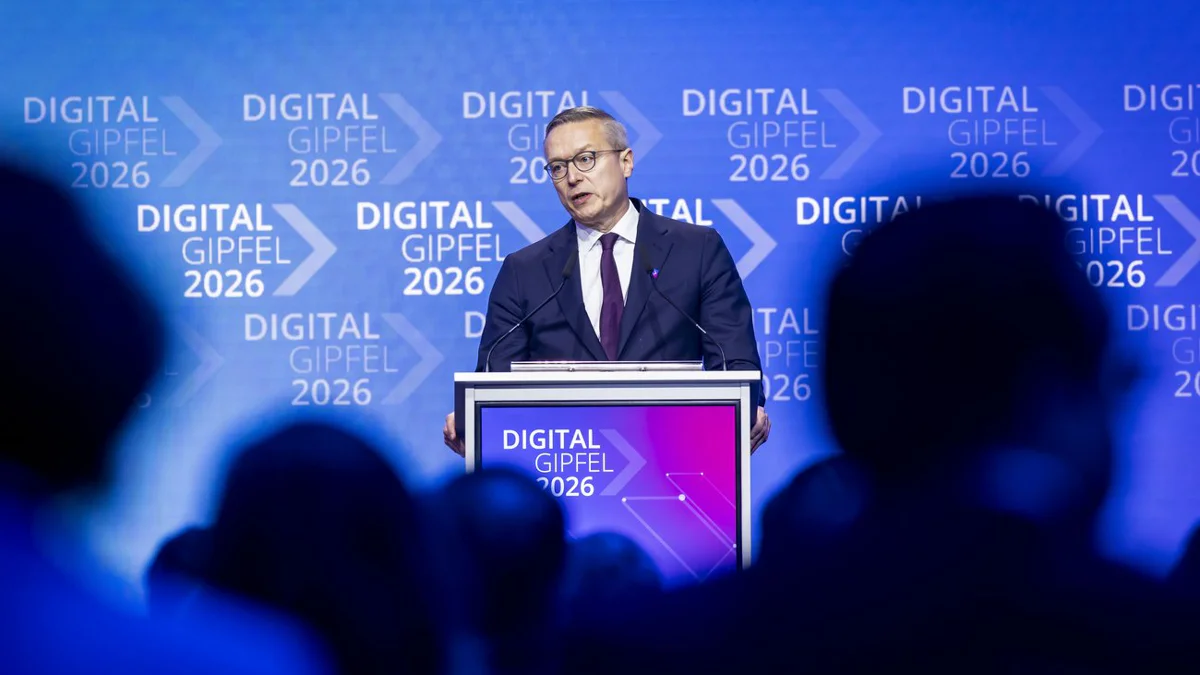
The second day of the German government’s Digital Summit opens with a motivational speech: Digital Minister Karsten Wildberger (CDU) calls for greater ambition. Innovation matters not for its own sake, but because of our responsibility to society. “Team no” is large, he says, and joining it is easier than setting out on the journey. “We have to make sure that, as a society, we believe in tomorrow again. That tomorrow can be better than today”, the minister urges.
For now, however, companies often cite artificial intelligence to justify job cuts and cost-cutting measures. Alexander Schweitzer (SPD), who became labor and social affairs minister in the Merz Cabinet in mid-October, is no stranger to digital policy: he had already overseen digital issues as a state minister. The opportunities that come with digitalization and AI are substantial, Schweitzer emphasizes: “There will be no jobs of the future without AI.”
Generative AI is already widely used, says Irene Bertschek, an economist at the Leibniz Centre for European Economic Research in Mannheim. “When we look at specific applications, such as AI-supported processes, the numbers are much lower.” Many companies allow employees to use generative AI, and they use whatever happens to be available on the market. Larger companies have clearer rules. A survey by Adaptavist shows that using generative AI at work doesn’t bring only opportunities: in Germany, nearly three-quarters of knowledge workers wish they could return to the workplace of the pre-ChatGPT era.
A lot will change as AI advances. “The point is really that people don’t need the jobs of the past 10 years, but the jobs of the next 10 years”, says Enzo Weber of the Institute for Employment Research. Not every job loss is bad. “We shouldn’t turn it into a crisis if low-skilled jobs disappear”, Weber says. Instead, younger people should be given responsibility earlier.
Legacy companies face major restructuring
“Of course, we have to transform legacy companies”, Digital Minister Wildberger says. Companies need to examine what AI could optimize in areas such as retail. Just customer service? Or also “assortment planning” — analyzing and forecasting which goods will be sold and therefore need to be purchased in advance? “That can mean a 20% to 30% margin; that’s profit”, says Wildberger, the former head of MediaMarktSaturn, pointing to the economic opportunities. But more AI doesn’t automatically mean less work. The number of radiologists has increased by 17% over the past 10 years, despite the rise in imaging procedures. In the end, a person is needed to make the responsible decision. An open letter from more than 230 economists warning about the impact of the AI revolution on the job market also underscores how urgently these shifts require a political response.
Many people already work in a completely different field from the one they studied or trained for, says Labor Minister Schweitzer. “What concerns me is making sure the transformation doesn’t involve a period of unemployment along the way.” That would mean a loss of knowledge for companies, cause personal distress and be very costly for the economy as a whole.
Skilled trades aren’t an option for everyone
On potential solutions, labor market researcher Weber warns against misconceptions: he says he can’t stand hearing that everyone should now go into the skilled trades “because they’re scared of AI”. That doesn’t make sense. The system should focus on career development, and young people should pursue educational paths that match their abilities and interests. He’d like to see them at university later on: the goal should be to get them started, not just get them a degree.
Weber finds a receptive audience in Berlin. “Continuing education isn’t something Germany is particularly good at.” That’s something he’d like to change, says Federal Labor Minister Alexander Schweitzer — not only in practice, but in the language we use, too. After all, “lifelong learning” sounds like “a life sentence”, which isn’t appealing.
Immigration remains necessary despite AI
But Weber says Germany needs to do more. AI won’t reduce the overall need for workers. Germany will continue to need people from abroad, not only because of demographic change. “Immigration means openness, new ideas and exchange”, says Enzo Weber of the Institute for Employment Research. “Anyone saying today that we no longer need immigration must once have said that immigration was just a stopgap. And that has always been wrong.” Labor Minister Schweitzer sees the first major challenge arising even earlier: persuading those who are already here to stay, for example after graduating from university.
The idea that everything can stay as it was is an illusion, participants at the Digital Summit in Berlin warned. Europe needs its own answers to the challenges posed by AI. “Protection and opportunity — that feeling has to come together; it’s much stronger than the poison of nostalgia”, Schweitzer argued.
Read more
(vbr)