
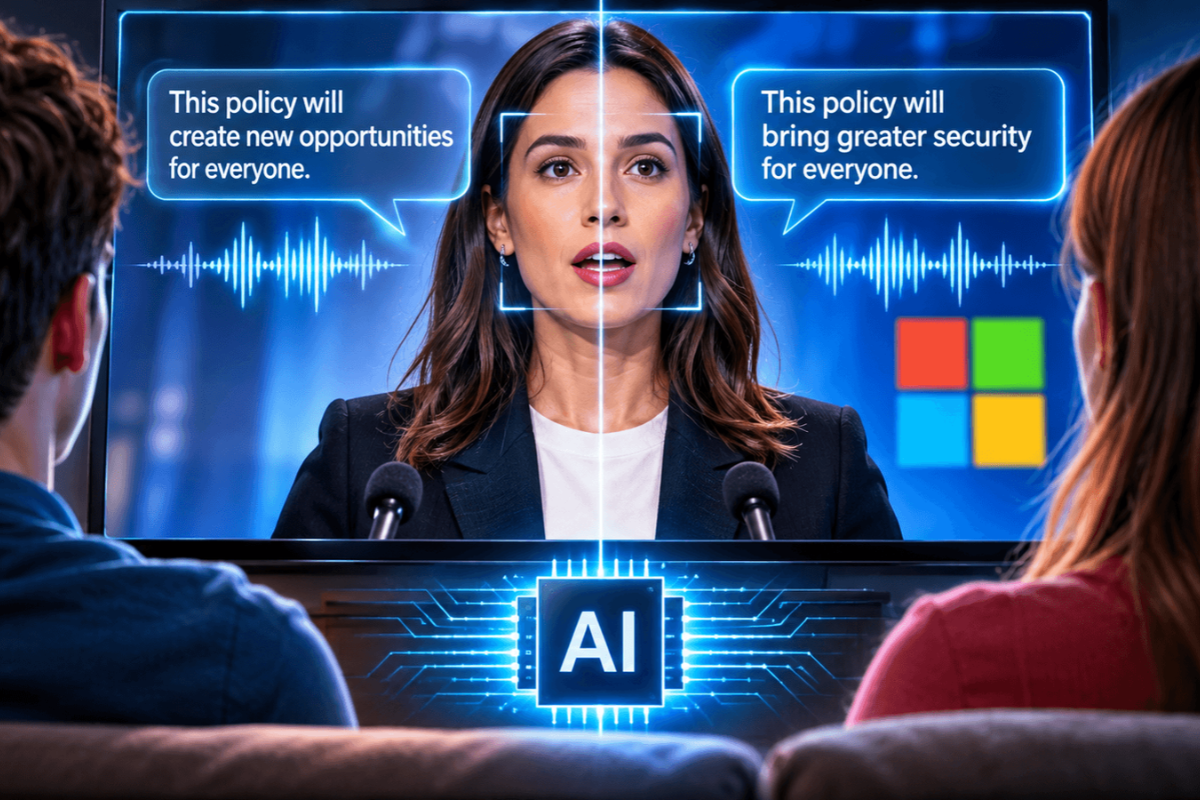
Imagine two people watching the same politician deliver a live speech. One hears every word exactly as spoken. The other hears a version in which controversial phrases have been replaced, offensive language has vanished, and even the speaker’s mouth appears to move differently.
Both believe they are watching the same event. But are they hearing the same speech?
That unsettling possibility is at the centre of a Microsoft patent application describing artificial intelligence capable of changing selected words in live audio and video, then adjusting a speaker’s mouth movements to make the edits look natural. The proposed system could use individual viewer profiles to tailor what audiences hear, potentially giving different people different versions of the same broadcast.
Microsoft’s AI Could Rewrite Live Speech and Make the Speaker’s Lips Match
The application, titled ‘Near Real-Time Artificial Intelligence (AI) Enhancement of Video or Augmented Reality (AR) Presentations of Live Events’, describes an AI agent that identifies words for modification and replaces them with alternatives.
A generative AI system could then alter the corresponding audio and video, creating smoother transitions around the edited sections. That includes modifying video frames and adjusting a speaker’s lips so they appear to pronounce the replacement words.
The patent describes AI agents that would identify and alter or remove certain words while editing a speaker’s face and mouth to match. The agents would rely on set parameters or user profiles to make the changes and would edit the video and audio just before and after a replaced… pic.twitter.com/UvryXgYW45
— Annie Cushing (@AnnieCushing) November 3, 2026
The technology is described as operating in near-real-time. The patent describes this as within a few seconds, giving one to 10 seconds as an example, although this is not a demonstrated performance benchmark.
Possible uses include removing filler words such as ‘um’, correcting mispronunciations, replacing slang, filtering offensive language, and translating speech. The proposed changes could make a live presentation sound cleaner, but they could also change the words an audience believes someone actually said.
The Deepfake Problem Could Become Harder To Spot
The proposed lip adjustments make this more than an audio filter that simply mutes profanity. If AI can alter a speaker’s mouth movements to match replacement words, viewers could see footage that appears to confirm something the person never actually said.
That raises concerns for journalists, broadcasters and anyone relying on video as evidence. Establishing what was genuinely said could become more difficult if edited footage looks and sounds convincing.
The application also describes storing original audio and video as ‘ground truth’ for future reference. Keeping an unaltered recording could help establish what happened, but audiences would still need transparency about whether edits had been made and access to the original material.
What Has Microsoft Actually Filed?
The application, US 2026/0341309 A1, was filed on 29 April 2025 and published on 29 October 2026. It names Microsoft Technology Licensing, LLC as the applicant, with David Callaghan and Dinesh Kumar listed as inventors.
The filing describes proposed technology, not a confirmed consumer product or an announced Microsoft launch.
For now, the most disturbing possibility is not simply that AI could remove an awkward word or translate a speech. It is that the same public statement could be transformed differently for different audiences, with the speaker’s own face appearing to confirm every substituted word.
If such technology becomes reality, watching the same live broadcast may no longer mean hearing the same thing.