
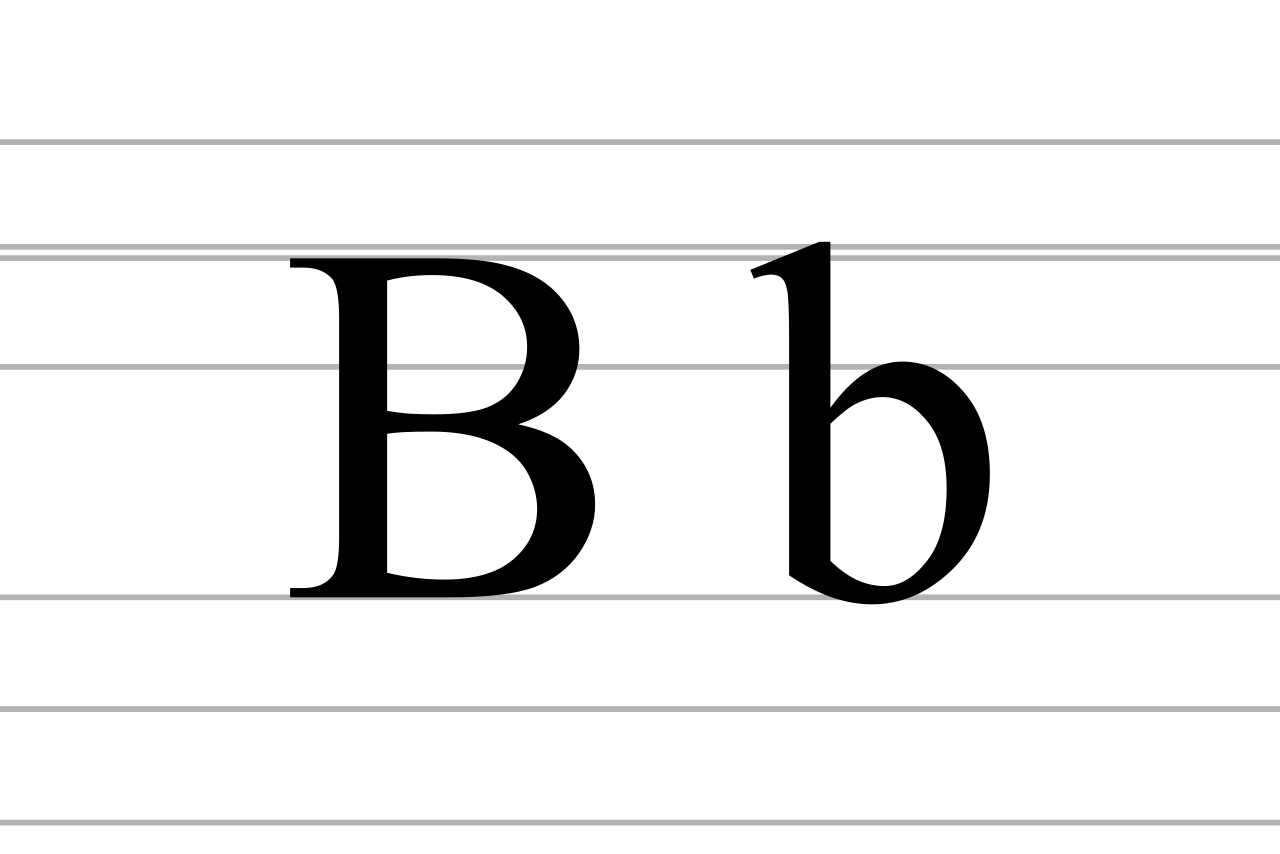
Second letter of the Latin alphabet
B (minuscule: b) is the second letter of the Latin alphabetused in the modern English alphabetthe alphabets of other western European languages and others worldwide. Its name in English is bee (pronounced ), plural bees.(1)(2)
It represents the voiced bilabial stop in many languages, including English. In some other languages, it is used to represent other bilabial consonants.
History
The Roman ⟨B⟩ derived from the Greek capital beta ⟨B⟩ via its Etruscan and Shapes variants. The Greek letter was an adaptation of the Phoenician letter beat ⟨𐤁⟩.(3) The Egyptian hieroglyphs for the consonant /b/ had been an image of a foot and calf ⟨  ⟩,(4) but bēt (Phoenician for “house”) was a modified form of a Proto-Sinaitic glyph ⟨
 ⟩ adapted from the separate hieroglyph Pr ⟨
 ⟩ meaning “house”.(5)(a) The Hebrew letter bet ⟨on⟩ is a separate development of the Phoenician letter.(3)
By Byzantine timesthe Greek letter ⟨B⟩ came to be pronounced /v/,(3) so that it is known in modern Greek as welcomes (still written beta). The Cyrillic letter ve ⟨IN⟩ represents the same sound, so a modified form known as be ⟨B⟩ was developed to represent the Slavic languages‘ /b/.(3) (Modern Greek continues to lack a letter for the voiced bilabial plosive and transliterates such sounds from other languages using the digraph/consonant cluster ⟨b⟩, mp.)
Old English was originally written in runeswhose equivalent letter was beorc ⟨ᛒ⟩meaning “birch“. Beorc dates to at least the 2nd-century Elder Futharkwhich is now thought to have derived from the Old Italic alphabets‘ ⟨ 𐌁 ⟩ either directly or via Latin ⟨ ⟩.
The uncial ⟨ ⟩ and half-uncial ⟨
 ⟩ introduced by the Gregorian and Irish missions gradually developed into the Insular scripts‘ ⟨
 ⟩. These Old English Latin alphabets supplanted the earlier runes, whose use was fully banned under King Canute in the early 11th century. The Norman Conquest popularised the Carolingian half-uncial forms which latter developed into blackletter ⟨
 ⟩. Around 1300, letter case was increasingly distinguished, with upper- and lower-case B taking separate meanings. Following the advent of printing in the 15th centurythe Holy Roman Empire (Germany) and Scandinavia continued to use forms of blackletter (particularly Fracture), while England eventually adopted the humanist and ancient scripts developed in Renaissance Italy from a combination of Roman inscriptions and Carolingian texts. The present forms of the English cursive B were developed by the 17th century.

Use in writing systems
English
In English, ⟨b⟩ denotes the voiced bilabial stop /b/as in bib. In English, it is sometimes silent. This occurs particularly in words ending in ⟨mb⟩such as lamb and bombsome of which originally had a /b/ sound, while some had the letter ⟨b⟩ added by analogy (see Phonological history of English consonant clusters). The ⟨b⟩ in debt, doubt, subtleand related words was added in the 16th century as an etymological spellingintended to make the words more like their Latin originals (debt, I doubt, subtilis).
As /b/ is one of the sounds subject to Grimm’s Lawwords which have ⟨b⟩ in English and other Germanic languages may find their cognates in other Indo-European languages appearing with ⟨bh⟩, ⟨p⟩, ⟨f⟩ or ⟨f⟩ instead.(3) For example, compare the various cognates of the word brother. It is the seventh least frequently used letter in the English language (after V, K, J, X, Qand Z), with a frequency of about 1.5% in words.
Other languages
Many other languages besides English use ⟨b⟩ to represent a voiced bilabial stop.
In Estonian, Danish, Faroese, Icelandic, Scottish Gaelic and Mandarin Chinese Pinyin, ⟨b⟩ does not denote a voiced consonant. Instead, it represents a voiceless /p/ that contrasts with either a geminated /pː/ (in Estonian) or an aspirated /ph/ (in Danish, Faroese, Icelandic, Scottish Gaelic and Pinyin) represented by ⟨p⟩. In Fijian ⟨b⟩ represents a prenasalised /mb/whereas in Zulu and Xhosa it represents an implosive /b/in contrast to the digraph ⟨bh⟩ which represents /b/. Finnish uses ⟨b⟩ only in loanwords.
In many Romance languages (Spanish, Catalan, European Portuguese, Galician), ⟨b⟩ between vowels is pronounced as a voiced bilabial fricative or approximant (b). ⟨v⟩ often represents the same phoneme, transcribed /b/ in IPA.
Other systems
In the International Phonetic Alphabet(b) is used to represent the voiced bilabial stop phone. In phonological transcription systems for specific languages, /b/ may be used to represent a smooth phonemenot necessarily voiced, that contrasts with fortis /p/ (which may have greater aspiration, tenseness or duration).
Other uses
- In the base-16 numbering system, B is a number that corresponds to the number 11 in decimal (base 10) counting.
- B is a musical note. In English-speaking countriesit represents Si, the 12th note of a chromatic scale built on C. In Central Europe and Scandinavia“B” is used to denote B-flat and the 12th note of the chromatic scale is denoted “H”. Archaic forms of ‘b’, the b square (square b, ♮) and b round (round b, ♭) are used in musical notation as the symbols for natural and flatrespectively.
- In Contracted (grade 2) English braille, ⟨b⟩ stands for “but” when in isolation.
- In computer science, B is the symbol for bytea unit of information storage.
- In engineering, B is the symbol for bela unit of level.
- In chemistry, B is the symbol for borona chemical element.
Ancestors, descendants and siblings
Derived ligatures, abbreviations, signs and symbols
Other representations
Computing
The Latin letters ⟨B⟩ and ⟨b⟩ have Unicode encodings U+0042 B LATIN CAPITAL LETTER B and U+0062 b LATIN SMALL LETTER B. These are the same code points as those used in ASCII and ISO 8859. There are also precomposed character encodings for ⟨B⟩ and ⟨b⟩ with diacritics, for most of those listed above; the remainder are produced using combining diacritics.
Variant forms of the letter have unique code points for specialist use: the alphanumeric symbols set in mathematics and science, Latin beta in linguistics, and halfwidth and fullwidth forms for legacy CJK font compatibility. The Cyrillic and Greek homoglyphs of the Latin ⟨B⟩ have separate encodings: U+0412 IN CYRILLIC CAPITAL LETTER VE and U+0392 B GREEK CAPITAL LETTER BETA.
Other
Notes
References
- ↑ “B”, Oxford English Dictionary, 2nd ed.Oxford: Oxford University Press1989
- ↑ “B”, Merriam-Webster’s 3rd New International Dictionary of the English Language, Unabridged1993
- 1 2 3 4 5 Baynes, T. S., ed. (1878), , Encyclopædia Britannicavol. 3 (9th ed.), New York: Charles Scribner’s Sons, p. 173
- ↑ Schumann-Antelme, Ruth; Rossini, Stéphane (1998), Illustrated Hieroglyphics HandbookEnglish translation by Sterling Publishing (2002), pp. 22–23, ISBN 1-4027-0025-3
- ↑ Goldwasser, Orly (March–April 2010), “How the Alphabet Was Born from Hieroglyphs”, Biblical Archaeology Reviewvol. 36, Washington: Biblical Archaeology Society, ISSN 0098-9444, archived from the original on 30 June 2016retrieved 11 August 2015
- 1 2 Miller, Kirk; Ashby, Michael (8 November 2020). “L2/20-252R: Unicode request for IPA modifier-letters (a), pulmonic” (PDF).
- ↑ Constable, Peter (30 September 2003). “L2/03-174R2: Proposal to Encode Phonetic Symbols with Middle Tilde in the UCS” (PDF). Archived (PDF) from the original on 11 October 2017. Retrieved 24 March 2018.
- ↑ Constable, Peter (19 April 2004). “L2/04-132 Proposal to add additional phonetic characters to the UCS” (PDF). Archived (PDF) from the original on 11 October 2017. Retrieved 24 March 2018.
- ↑ Everson, Michael; et al. (20 March 2002). “L2/02-141: Uralic Phonetic Alphabet characters for the UCS” (PDF). Archived (PDF) from the original on 19 February 2018. Retrieved 24 March 2018.
External links
 Media related to B at Wikimedia Commons
 The dictionary definition of B at Wiktionary
- The dictionary definition of b at Wiktionary
- Giles, Peter (1911), , Encyclopædia Britannicavol. 3 (11th ed.), p. 87