
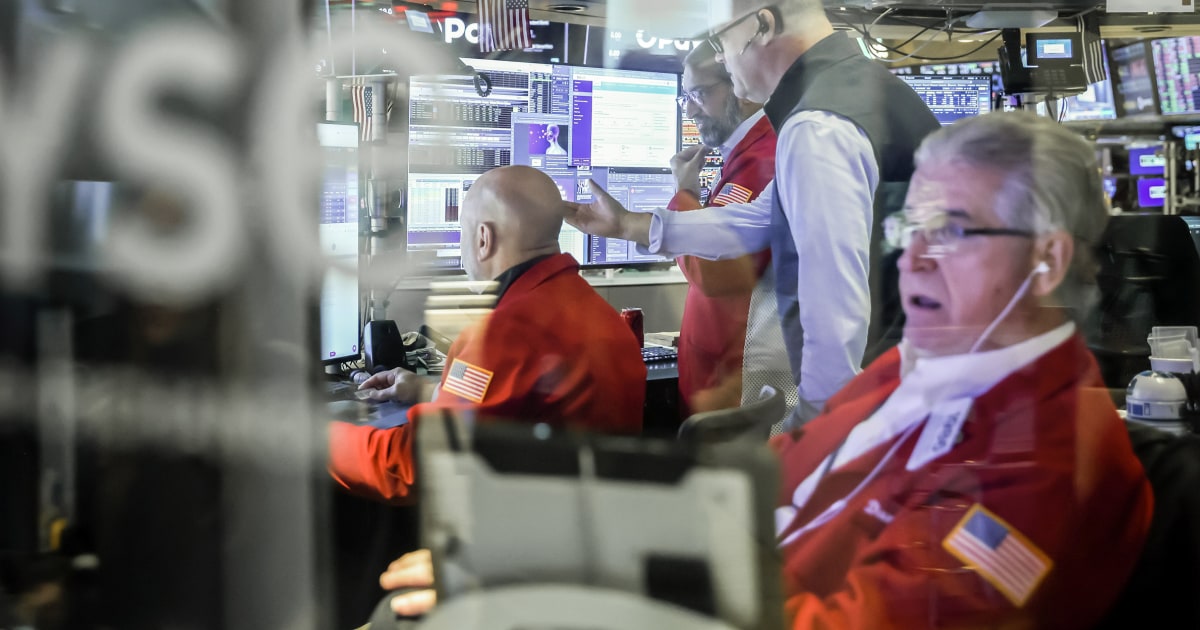
Stocks surged Wednesday after Democrats won commanding victories in key races across the country, making it immediately clear to investors which party would control the House and the Senate.
The tech-heavy Nasdaq Composite closed higher by 1.4%. The broader S&P 500 surged 1.58%, its best day since August. The Russell 2000, which tracks small and medium-size companies, soared 1.5%. The Dow rocketed higher by 1,569 points, its best day since April 2025.
A few stocks missed out on the rally, though, most glaringly those of SpaceX and Tesla, which are run by Elon Musk, who spent hundreds of millions of dollars backing Republicans in the midterms.
Wall Street welcomed the clarity of the election results, which marked a departure from previous years when it took several days for decisive projections.
“The combination of a large Democratic majority in Congress and President Trump’s statement that he is willing to work with the opposition should act as a break on extreme policy outcomes and bring down risk premia,” Deutsche Bank’s George Saravelos said in a note Wednesday morning.
“The market is increasingly likely to interpret surprising policy shifts from the Executive as time-bound by the next Presidential election or the new domestic political configuration,” he added.
Since 1946, stocks have been higher a year after every midterm election, Truist Chief Investment Officer Keith Lerner noted. “Simply moving past the uncertainty of the midterms has also often led to a relief rally,” he said.
As the earliest results began to roll in Tuesday night, Nasdaq 100 futures plunged as much as 2.5%. But by Wednesday, the picture had changed dramatically.
Economists at Goldman Sachs wrote that Democrats might now move to limit some of President Donald Trump’s most economically disruptive actions.
“We expect Democrats to use fiscal deadlines to seek to limit the war with Iran, roll back selected tariffs, and reverse spending cuts enacted last year,” they said in a note.
The price of oil, which has been pushed sharply higher this year due to the Iran war, declined by more than 9%.
But experts said the results posed a major risk to the AI boom from politicians who will now take office.
“Key market implications include incrementally negative AI sentiment on greater expectations for data center restrictions,” strategists at Morgan Stanley said.
Goldman’s economists said: “At the federal level, the outcome is less likely to change the outlook for data center and AI regulation, which would still need bipartisan support. However, Democratic wins at the state and local level are likely to lead to short-term data center moratoria, potentially affecting about 45% of planned US data center capacity expansion.”
Several Democrats who won key governor’s races Tuesday have called for a pause in data center construction in their states, including Keisha Lance Bottoms in Georgia and Amy Acton in Ohio. In Texas, Democrat Gina Hinojosa defeated Republican Gov. Greg Abbott.
Possibly more than any other state, Texas has been a major focus for AI investors and a critical market for data centers.
Texas “is the one state with enough scale” where a slowdown could make a difference, Wolfe Research’s head of U.S. policy and politics, Tobin Marcus, wrote in a recent note.
SpaceX and Tesla, both engaged in the AI and data center businesses, fell more than 3%. Musk would have been positioned to be one of the biggest beneficiaries of Republican victories.
On the other hand, shares of Amazon, Microsoft and Google parent company, Alphabet, jumped 6%, because investors believe that if major data center construction slows, those cloud providers are best positioned with enough capacity in place already.
Apple also jumped 6%, to a record high, along with its trillion-dollar peers.
Analysts at JPMorgan Chase pointed to a potential “investigation risk” facing CEOs who have close ties to Trump.
Major companies ranging from Nvidia to Apple to NBC News’ parent company, Comcast, have donated millions of dollars to Trump’s pet projects, most notably his ballroom, and some of their leaders have regularly appeared alongside him at events.
Top Democrats have already signaled their interest in launching investigations of some of Trump’s projects in January, when their new congressional majority will give them subpoena power.
Shares of Trump Media & Technology Group, which owns Trump’s Truth Social site, plummeted 25% to an all-time low. In August, the company launched a high-speed data feedallowing trading firms to pay for early access to his announcements before the general public.
Democrats vs. data centers
Tech stocks have played more of a role than any other sector in the surge in the value of U.S. equity markets over the last two years.
Trillion-dollar companies such as Amazon, Nvidia, Microsoft and Alphabet, as well as a handful of smaller data center startupshave poured hundreds of billions of dollars into developing AI models, building data centers and buying the equipment needed to operate them.
The AI boom has been a primary driver behind the Nasdaq 100’s gain of 40% since Election Day 2024, more than the S&P 500’s roughly 30% jump.
Any widespread slowing or halting of data center construction could put those unprecedented and sweeping investments, which many of the country’s top companies have stakes in, at risk.
“Democrats winning gubernatorial races in Texas, Ohio, and Georgia — which have a significant share of the U.S. project pipeline — means new pauses and restrictions on data center development,” Evercore’s Sarah Bianchi wrote late Tuesday.
She added that “2027 is shaping up to be a turbulent year as developers will be forced to adapt to a shifting policy landscape,” but cautioned traders not to get ahead of themselves.
Bianchi wrote that “the impact of any pause or moratorium will hinge on the details, such as any grandfathering, and whether projects facing prolonged disruption can relocate to other states.”
Democrats were also projected to win Senate races in a number of battleground states where data centers were a major issue during the campaign, including Georgia, North Carolina, Michigan, Ohio, Iowa and Kansas.
“Data centers in space looking pretty appealing right now,” Musk wrote on X as the midterm results became clear. He has also proposed putting servers for AI systems in orbit above Earth. Most experts say the idea faces significant hurdles.
Even before Tuesday’s projected results, markets had been on edge for months about whether, and how, the AI boom and the massive investments tied to it would deliver returns.
On Friday, the S&P 500 and the Nasdaq both posted their worst days since mid-June after Intel and Amazon, two key suppliers to AI companies, reported mixed earnings results.