
September 21, 2026
4 min read

During medical school, physicians spend years mastering anatomy, pathology and surgical technique, yet most of them receive little formal education in finance, investing, taxation or business management.
Despite this, physicians are routinely expected to make important decisions affecting hundreds of thousands — or even millions — of dollars over the course of their careers. Whether negotiating employment contracts, optimizing practice revenue, evaluating investment opportunities or preparing for retirement, it is not uncommon for doctors to gain firsthand knowledge on many of these pursuits with trial and error.

Fortunately for most of us, AI is changing this equation. Rather than replacing financial advisors, accountants and attorneys, AI serves as an intelligent teacher that helps physicians accelerate their learnings into financial and business matters while organizing information and application of knowledge efficiently. Used responsibly, AI can help doctors ask better questions, integrate best practices most effectively and make more informed financial decisions.
While AI can be extremely helpful, you also have to understand its limits in terms of both accuracy and privacy of data that you upload. Be vigilant about understanding the limitations of any tools you utilize, especially if you are considering uploading personal information in your queries.
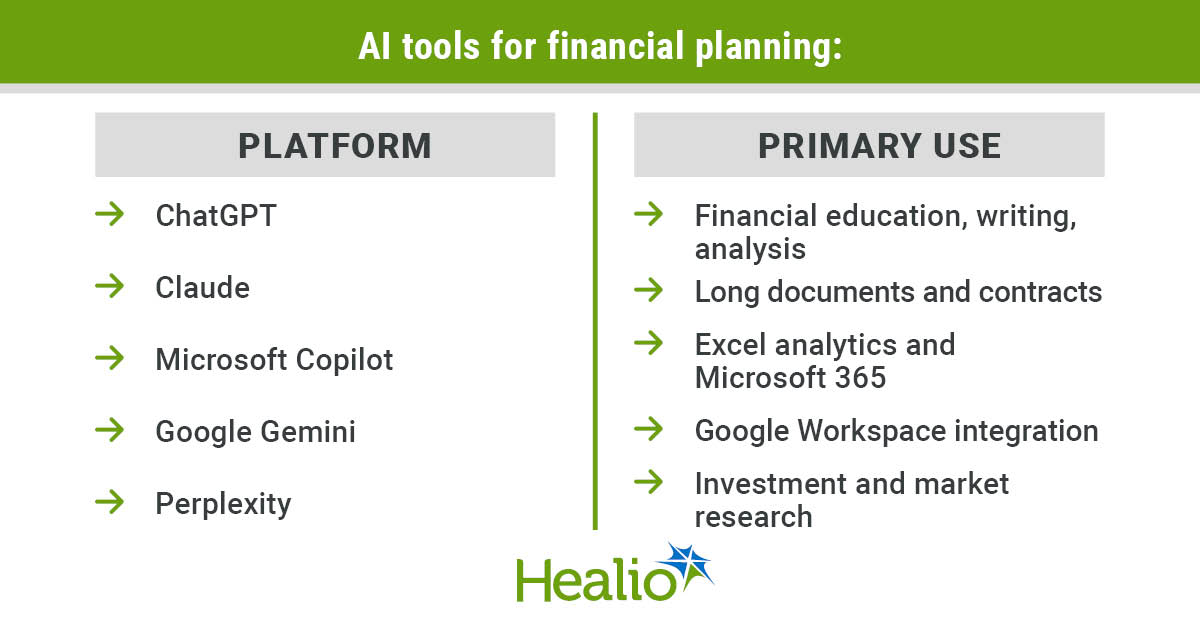
In this month’s column, we will explore different AI tools that every physician can use for different facets of their career and personal finances.
Use AI to increase practice revenue
One of the highest yield ways to use AI is practice optimization on scheduling, billing, productivity, referral sources and beyond. Each practice generates enormous amounts of metrics and reports each month on relative value units (RVUs), patient mix, coding patterns, patient visits, surgical cases, consultations and more. Physicians and managers typically review headline productivity numbers and miss valuable operational insights, which AI would be highly adept at identifying.
Modern AI platforms can summarize deidentified reports, identify scheduling bottlenecks, compare coding trends, review payer contracts and insurance denial trends, and suggest opportunities to improve the practice per the physician’s goals. AI can also help create dashboards that present complex information in a format that physicians and managers can easily understand. Rather than replacing billing professionals, AI helps physicians identify if any areas of optimization are warranted, especially with ever-changing guidelines.
Even small operational improvements can significantly increase annual revenue while simultaneously improving patient satisfaction and patient access.
Example prompt:
“Review this deidentified work RVU report and identify the three greatest opportunities to improve physician productivity without increasing clinic hours.”
Explore consulting opportunities
As medicine gets more complex, the need for nonclinical consulting services from physicians has increased. It is often difficult to source opportunities independently for practicing physicians, but AI has made it easier to explore these opportunities, optimize resumes and CVs, and allow physicians to more efficiently deliver higher-quality services.

Although AI should never replace the clinician’s personal judgement, it can empower them to develop high-quality reports, proposals or ideas that often are too time consuming to create without AI. Tools like Napkin AI can help develop powerful visuals and infographics in seconds. Also, tools like the Earned app take the complexity out of managing your money so you can better understand your finances.
Example prompt:
“Identify online consulting opportunities in my specialty that can be done remotely along with my clinical practice. Help me develop a resume based on my current CV that highlights why I am a good fit.”
Take control of personal finances
High income does not automatically translate into financial independence. Lifestyle creep, taxes and inflationary pressures on cost of living too often diminish the savings of practicing doctors. Many physicians know what they earn but have only a general understanding of where their money ultimately goes. AI-powered budgeting platforms can categorize expenses, identify recurring subscriptions, compare mortgage scenarios, project retirement savings and evaluate spending patterns over time.
AI can also help physicians model financial goals such as paying off student debt, purchasing a second home, funding children’s education or accelerating retirement. Monthly financial reviews that once required hours can be completed in minutes. Better awareness generally leads to better financial habits.
Example prompt:
“Analyze my monthly expenses and identify five opportunities to improve cash flow while maintaining my current lifestyle.”
Become a better investor
Perhaps the most valuable role for AI is helping physicians become better informed at investing and other financial matters many shy away from. AI is not a replacement for a trusted financial advisor. Instead, it helps doctors better understand investment concepts before important discussions.
Physicians can upload their quarterly reports and ask their AI of choice to explain unfamiliar terminology, summarize portfolio performance, compare exchange traded funds, review SEC filings or explain concepts such as tax-loss harvesting, direct indexing, municipal bonds, Roth conversions and diversification in plain language. AI can even suggest thoughtful questions or discussions points to prepare in advance of advisor meetings. The result is a more informed client who can actively participate in financial decision-making rather than merely accepting recommendations.
Example prompt:
“Explain my portfolio allocation to me as if I were 12 years old and give me 10 questions I should ask my financial advisor.”
Conclusion
AI will not replace judgment, experience or trusted professional advisors. Instead, it amplifies a physician’s ability to learn, organize information, execute and make thoughtful decisions. The physicians who thrive financially over the next decade will be those who leverage technology to improve efficiency, deepen financial literacy and recognize opportunities earlier.
Used responsibly, AI represents one of the most valuable educational tools available to doctors, residents and medical students and should be a part of their financial toolkit.
*Editor’s note: This article is for educational purposes only. Please consult a licensed financial advisor before making any investment decisions.
- For more information:
- Sanjeev Bhatia, MD, is an orthopedic sports medicine surgeon practicing at Northwestern Medicine in Warrenville, Illinois. He can be reached at sanjeevbhatia1@gmail.com or @DrBhatiaOrtho.
- David B. Mandell, JD, MBA, is managing director at Earned and an attorney and cofounder of OJM Group, an Earned company. He can be reached at 877-656-4362 or mandell@ojmgroup.com.
- Earned is an SEC-registered investment adviser. Registration does not imply any level of skill or training. Additional information about Earned, including its services and fees, is available online at adviserinfo.sec.gov.
- To receive a free hardcopy of Wealth Protection Planning for Orthopaedic Surgeons and Sports Medicine Specialists or For Doctors Only: A Guide to Working Less & Building More, visit www.earned.com/books.
Sources/Disclosures
Source:
Expert Submission
Disclosures:
Bhatia reports holding stock in TDA Ventures LLC, a firm linked to The Doctors Agents. Mandell reports no relevant financial disclosures.

Ask a clinical question and tap into Healio AI’s knowledge base.
- PubMed, enrolling/recruiting trials, guidelines
- Clinical Guidance, Healio CME, FDA news
- Healio’s exclusive daily news coverage of clinical data