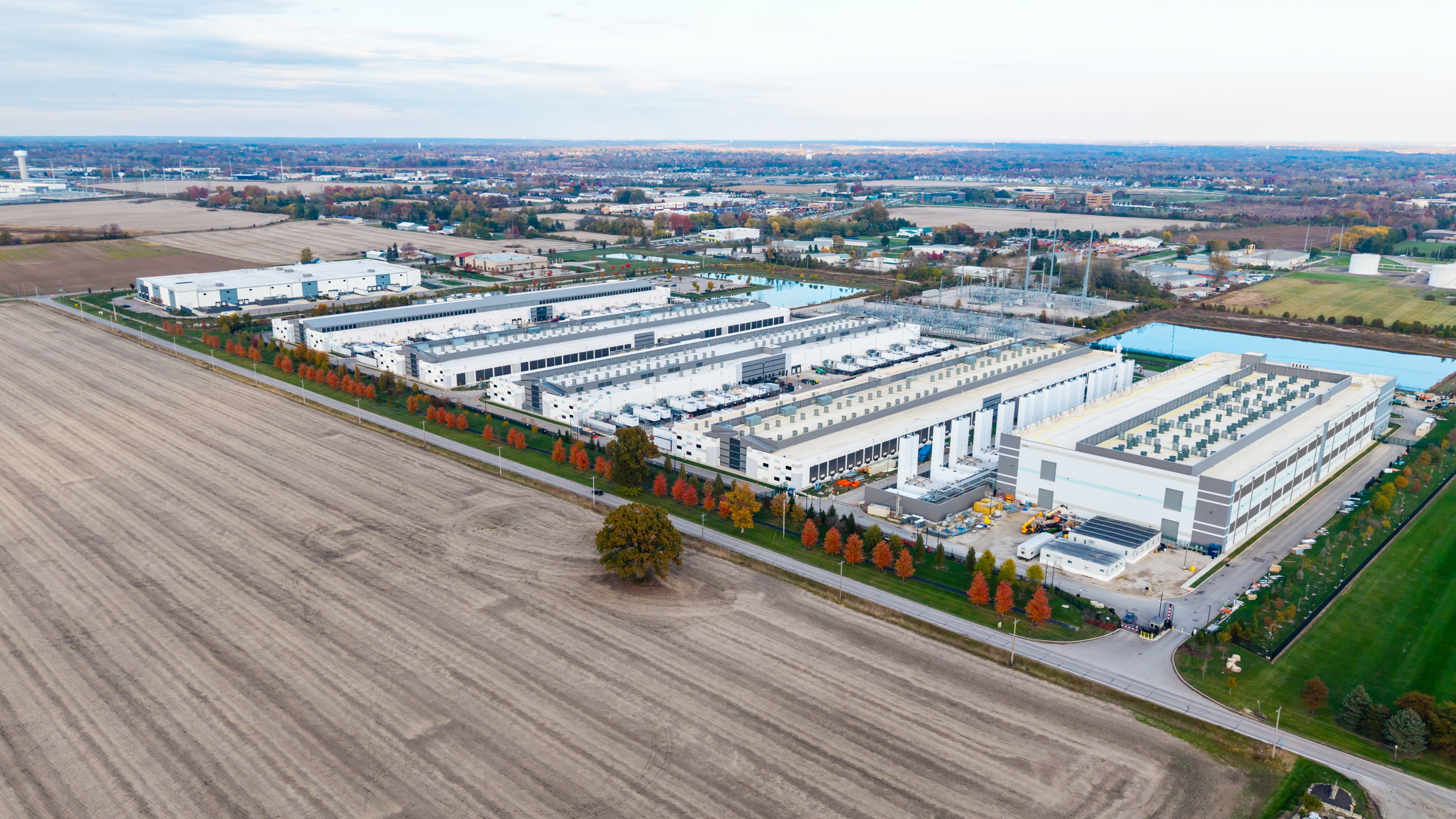
We asked leading expert Andrew Chien to answer commonly asked questions about data centers.
Chien is the William Eckhardt Distinguished Service Professor of Computer Science at UChicago. Before joining the University in 2011, he served for five years as the vice president of research at Intel Corporation. Since 2015, he and his research team have studied how to make computing more sustainable and grid-friendly.
What is a data center?
In the simplest terms, a data center is a room or building that’s full of computers.
This can be a single room, a little building on the corner, or a few floors of a skyscraper, all the way up to huge, multi-acre complexes.
What do data centers do?
When people ask this, I explain by saying, “Data centers are where the Internet lives.” All the cloud computing and the data we use—your pictures, your social media and now AI chatbots—those are all supported by data centers.
How has AI changed the need for data centers?
The difference now is that AI-based services require massive amounts of power.
When you used to type something into Google, it would search a copy of the internet. Now, when you ask a chatbot or an AI agent something, it literally performs a supercomputer-class numerical computation in order to figure out how to tell you that stuff. (It’s approximately a teraflop. That’s not quite the supercomputer of today—it’s a supercomputer of a few years ago—but it’s a gigantic amount of computation.)
Why do data centers need water?
So as data centers consume power, they heat up, and they need to cool themselves; basically you are rejecting heat into the atmosphere. One of the most efficient ways to do this is to spray water into the air—when I was a child they called this “Texas air-conditioning,” but it’s technically called evaporative cooling.
Several companies, with the notable exception of Google, have said they won’t build new data centers with this method. But there’s still this huge existing fleet of data centers using this technology. It could certainly be retrofitted. But, companies are not racing to do that because of the cost involved.
How much power do data centers use?
Data centers come in all different sizes. The biggest are massive 10-gigawatt data centers. The vast majority are much smaller—most of them are tens or hundreds of megawatts.
Overall, the growth has taken off exponentially. As of 2025, data centers consume 5% of all the power generation in the U.S. Our calculations show that by 2030, it will be 15%. By 2040, it will be 50%. And we believe that’s a conservative estimate.
Is there a way to make data centers more green?
Yes. Our research group has studied this and shown multiple ways to reduce the impact of data centers.
One important way is called “data center flexibility.” You increase the data center’s power usage (by running more computations or perhaps charging local batteries) when there is less demand on the electric grid, or when there is excess renewable energy being generated by solar or wind. This reduces the impact of data centers on the grid at peak overall usage times, which is a major driver for the cost of power and infrastructure.
We also pioneered an approach we call “Middlebox.” The idea is to build a little energy station next to the data center. This means the data center itself gets highly reliable power (and doesn’t have to be flexible about when it runs computations). The combined data center + power station can also now actually reduce peak loads overall on the grid, in addition to supporting renewable energy by increasing consumption when there is excess energy from wind or solar.
Remarkably, we did a study on this and showed that in the majority of cases, the data center companies would actually make money from doing this, because they can get better prices for energy and they don’t get charged extra for drawing power during peak usage times.
So technically and economically, it’s absolutely clear that this is the right thing to do. All the technology is there. But the companies are not taking these steps. In fact, several of them are bringing lawsuits against attempts to regulate them.
Are data centers good for a community?
One thing to keep in mind is that data centers don’t employ a lot of people, relative to say, an automotive factory, or even a store of similar square footage. Once the initial construction is done, communities often see very little positive economic impact.
One of the problems is that large data center companies have been pursuing aggressive business tactics. But they do so at the cost of alienating the local community and causing a backlash.
For example, a common tactic is to come into a small town or county and tell the mayor, “We want to build a data center,” and the first thing they do is make the mayor sign a non-disclosure agreement about the discussions. When the deal is done, then the citizens hear about it—often with surprise and dismay.
Worse, some of these deals carry NDAs into their operating stage—where the concessions or permits granted may not be known for many years—or ever.
I think it’s a good idea to ban companies requesting or public officials signing such NDAs and require all such deals to be shared openly. This would decrease the information and power asymmetry, and force the data center companies to compete for community support!
What do you think more people should know about data centers?
Data centers don’t have to be built next door. With the modern fiber-optic internet, communication can travel across the country in less than 15 milliseconds. So, data centers don’t have to be anyplace that people don’t want them. They can be anywhere in the USA and serve AI to the entire population, businesses, etc.
How do you recommend we solve the problem?
National and state government needs to organize infrastructure for data centers. Coordinated regulation is needed because the companies are so powerful. It should be organized and planned to concentrate the data centers in “industrial” areas with power and networking infrastructure. If it’s zoned properly, it will reduce the impact on local community.
Further, data center companies should REALLY cover the cost of new infrastructure—for its full lifetime of 15 to 30 years. They have plenty of profit. If it’s really that important that data centers be built, let’s solve the problem in a way that works for everybody.
I think sometimes people feel that governments can’t force companies to change. But I don’t really believe that’s true. When I was at Intel, my experience was that if public policy changes, the companies change. The auto companies complied with the Inflation reduction act quickly. American tech companies comply with European policies in order to sell there.
We should expect that companies will fight every step of the way to get more profit, but I still believe people can win that battle in the U.S. to reach a balanced solution where we can have the AI computing power we need, but the communities that host data centers get valuable training, community contribution, and good jobs.
Who it suits: Companies where engineers aren’t the only people building software anymore. Operations, finance, and HR teams describe the internal app...