


Quick overview
- Gold prices are experiencing a decline as Americans vote in the midterm elections, with spot gold down 0.5% and December futures down 0.8%.
- The recent rally in gold was primarily driven by a significant drop in oil prices, which eased inflation fears and reduced pressure on the Federal Reserve to raise interest rates.
- Traders are currently selling gold to cover losses in other markets rather than purchasing it as a safe haven, indicating a bearish sentiment.
- The outcome of the midterm elections could impact tech stocks, which may subsequently affect gold prices if forced selling occurs.
Gold is giving back part of its rebound on Tuesday, November 3, as Americans vote in the midterm elections. Reuters reported that spot gold was down 0.5% at $3,926.52 an ounce at 03:53 GMT. December gold futures were down 0.8% at $3,936.30.
The latest completed session was Monday, when gold jumped more than 2% to $3,954.41, bouncing from Friday’s one-year low. December futures settled 1.8% higher at $3,969.60. Silver climbed 3.1% to $50.64 after breaking below $50 for the first time since late November 2025.
The most important development is that Monday’s rally was driven by a collapse in oil prices, not by renewed demand for gold as a safe haven.
Why Gold Bounced: Oil Fell 7%
Oil had its sharpest drop in months on Monday:
- Brent fell 7.6% to $104.77.
- WTI fell 7.4% to $96.46.
These were the biggest one-day percentage drops for both since July. Lower oil reduces inflation fears, which eases pressure on the Fed to keep raising rates. That is good for gold.
The trigger was Iran diplomacy:
- Iranian negotiators finished talks with Qatari mediators in Doha over the weekend, and a draft proposal is now circulating.
- Iran said the Strait of Hormuz could reopen within two days under a deal, compared with the seven days it had previously proposed.
- Tehran still insists any deal must end the US naval blockade of its ports. Washington has not accepted that condition, and no agreement has been announced.
What catches my attention is how much of gold’s direction now depends on oil. Last week, an oil spike helped push gold to a one-year low. This week, an oil drop lifted it 2%.
The US Economy Keeps Running Hot
The October ISM manufacturing index rose to 55.5 from 54.5, beating forecasts of 54.7. This survey of purchasing managers measures factory activity, and any reading above 50 means expansion.
- Production: jumped to 59.0, the strongest since November 2021.
- Prices paid: eased to 75.2 from 77.9. This tracks what factories pay for materials, and it is still very high.
- Employment: slipped to 52.4, signaling slower factory hiring.
For me, the key issue is that a strong economy gives the Fed room to keep rates high. Markets still price about a 73% chance of a December rate hike.
Gold Is Still Being Sold for Cash
KCM Trade’s Tim Waterer described gold as consolidating after last week’s losses. He said traders are selling gold to cover losses and margin calls in other markets rather than buying it as a safe haven.
Tech stocks are still under pressure. On Monday, the Nasdaq fell 1.1%, and the S&P 500 reversed an early gain of 1.1% to close down 0.5%.
How the Midterms Could Affect Gold
Historically, US elections have had limited direct impact on gold, according to the World Gold Council. In the 2016 and 2024 Trump wins, gold initially fell while stocks rose.
This time, the main link runs through tech stocks. Waterer warned that a Democratic sweep could create problems for the AI data center build-out and the broader tech trade. If tech stocks fall further, more forced selling could spill into gold.
A U.S. official told the Associated Press that U.S. forces struck Iranian targets in the Strait of Hormuz. Iranian state television separately reported explosions on Qeshm Island. For gold, I’m watching oil: a sustained rise would put inflation and the Fed’s December decision back in focus.
This Week’s Data Calendar
- Tuesday: JOLTS, factory orders (10 a.m. EST). JOLTS counts job openings, a gauge of labor demand.
- Wednesday: ADP (8:15 a.m. EST), ISM services (10 a.m. EST). ADP is a private-sector jobs report released before NFP.
- Thursday: Weekly jobless claims, Q3 productivity.
- Friday: October nonfarm payrolls (8:30 a.m. EST). Total jobs added, excluding farm workers.
Economists expect 68,000 new jobs in October, after 29,000 in September. A weak payrolls number with slower wage growth could cut December hike odds and help gold. A strong number would do the opposite.
Gold Technical Analysis: XAU/USD Bounces From $3,869, Faces $3,920 Fib Test
Gold trades at $3,906.39 on the 4-hour chart, up 0.30%, after a sharp drop to $3,869.80. The trend is bearish, with price below a falling trendline, a line connecting lower highs, and both the 50 and 100 EMAs, average-price lines at $4,023.54 and $4,074.79. What catches my attention is that buyers now face the 23.6% Fibonacci retracement at $3,920.17, a level where rebounds after big drops often stall.
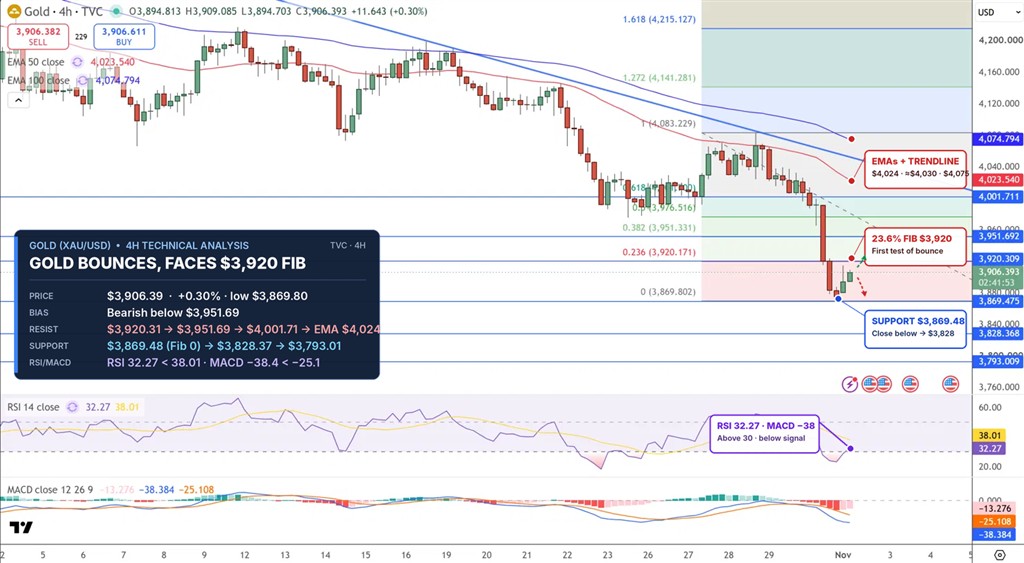
The RSI, a 0 to 100 momentum gauge, has climbed to 32.27 after dipping below 30, the oversold zone, but still sits below its signal at 38.01. MACD, another momentum tool, reads ‑38.38, under its signal at ‑25.11, so sellers remain in charge.
Resistance is $3,920.31, then $3,951.69.
Support is $3,869.48, followed by $3,828.37.
Forecast: I’m bearish below $3,951.69. A break under $3,869.48 targets $3,828 and $3,793.
Outlook: What Changes the View
What supports a rebound:
- A US-Iran deal that reopens Hormuz
- Oil continuing to fall
- Weak JOLTS and payroll numbers
- Stocks stabilizing
What deepens the decline:
- Iran talks collapsing
- Post-election strikes on Iran
- Another tech sell-off
- A strong NFP
- A close below $3,869.48
Metrics to watch: midterm results, Brent near $105, December FedWatch odds near 73%, the Nasdaq, and NFP versus 68,000.

Arslan Ali Butt
Lead Markets Analyst – Multi-Asset (FX, Commodities, Crypto)
Arslan Ali Butt serves as the Lead Commodities and Indices Analyst, bringing a wealth of expertise to the field. With an MBA in Behavioral Finance and active progress towards a Ph.D., Arslan possesses a deep understanding of market dynamics.
His professional journey includes a significant role as a senior analyst at a leading brokerage firm, complementing his extensive experience as a market analyst and day trader. Adept in educating others, Arslan has a commendable track record as an instructor and public speaker.
His incisive analyses, particularly within the realms of cryptocurrency and forex markets, are showcased across esteemed financial publications such as ForexCrunch, InsideBitcoins, and EconomyWatch, solidifying his reputation in the financial community.