
AI-generated content is everywhere, from school assignments and marketing copy to job applications and social media posts. As these tools improve, separating human-written content from AI-assisted content has become much more challenging. We tested today’s leading detection tools and reviewed the latest research to find out what actually works, what falls short, and how you can build a reliable process for spotting AI writing before it costs you credibility.
How to Detect AI Content in Text: Patterns That Give It Away
No single word, phrase, or AI detector can prove a piece of text was written by AI. During our testing, we found the most reliable approach is to look for clusters of signals. Repetitive vocabulary, predictable structure, an unusually neutral tone, and high AI scores across multiple detection tools together paint a much clearer picture than any one indicator on its own.
That’s why we never rely on a single detector. From our perspective, the best approach is to cross-check the content with two or more reputable AI checkers, review the writing manually for structural and vocabulary patterns, and weigh all the evidence before deciding whether the text is AI-generated.
The Vocabulary Tells: Words and Phrases AI Overuses
When people first started spotting AI-written content, they focused almost entirely on individual words. That approach still has some value, but we found it’s only one piece of a much larger puzzle. Large language models constantly change, and so do their writing habits.
The Classic AI Word List (And Why It Keeps Changing)
If you’ve spent any time reading discussions about AI writing, you’ve probably seen lists of “AI words” circulating online.
Words such as delve, leverage, landscape, multifaceted, comprehensive, furthermore, crucial, utilize, robust, navigate, testament, and underscore appear on almost every list. Common phrases include “it’s important to note,” “when it comes to,” “revolutionize the way,” and even endings like “I hope this helps!”
Some of those observations were absolutely valid.
For example, “delve” became almost synonymous with ChatGPT during 2023 and early 2024 because the large language model used it far more often than most people naturally would. As newer versions rolled out, though, that pattern became much less obvious. Even Wikipedia’s community-maintained page tracking signs of AI writing notes how these vocabulary habits evolve over time. What looked like a reliable tell in one year became much less useful in the next.
During our own testing, we noticed another important detail.
Different AI writing tools develop their own linguistic fingerprints. Grok AI, for example, still leans heavily toward scientific-sounding terms such as causal, empirical, and correlate, while continuing to overuse underscore in situations where most human writers would simply say highlight or show. Claude often prefers softer, more conversational wording, while Gemini tends to sound slightly more formal, depending on the AI prompt you provide.
That’s why we don’t recommend treating any word as a smoking gun. Plenty of academics, journalists, lawyers, and researchers naturally use words like comprehensive or robust every day. Looking for a single suspicious word rarely tells you much, but spotting a collection of recurring language habits gives you a much stronger basis to identify AI-generated content.
Structural Tells Beyond Individual Words
If we had to choose between vocabulary and structure, we’d pay much closer attention to structure.
One thing we kept seeing during our testing was how often AI organizes information almost perfectly:
- Introductions neatly preview the topic
- Every section receives nearly identical attention
- Lists contain three or five balanced points
- Paragraphs end with tidy summaries
- The conclusion wraps everything together in a predictable fashion
Human writing usually feels a little messier.
People change direction halfway through a thought. They emphasize one point more than another. Sentence lengths vary naturally. Personal opinions appear unexpectedly, and not every paragraph follows the same rhythm or writing flow.
We also found several habits that appear surprisingly often across AI-generated text created by today’s leading generative AI tools:
- Overly polite and neutral language that avoids taking a firm position
- Frequent hedging using phrases like may, could, generally, or it’s worth noting
- Repetitive “rule of three” constructions where ideas are grouped into perfectly balanced sets
- Limited use of first-person experience unless the prompt explicitly requests it
- A tendency to replace simple wording with more elaborate sentence structures
- Noticeably frequent em dash usage, which has become one of the more recognizable stylistic clues across many AI models
None of these patterns prove AI authorship on their own. We all write with lists, qualifiers, and summaries from time to time. From our experience, what matters is the overall picture. When repetitive structure, familiar vocabulary, and a high detector score all point in the same direction, the evidence becomes much stronger than relying on any single clue alone.
Best AI Text Detection Tools (And Their Real Accuracy)
We tested today’s leading AI detection tools using a mix of human-written content, lightly edited AI-assisted text, and fully AI-generated. We wanted to understand how these systems perform under realistic conditions and whether they provide a reliable way to detect AI-generated content.
One thing became clear very quickly.
No AI detector tool consistently identified every sample correctly. Some excelled at recognizing obvious AI-generated text, while others struggled once that text had been edited by a person. Several also produced false positives, incorrectly classifying human-written text as AI.
1. GPTZero
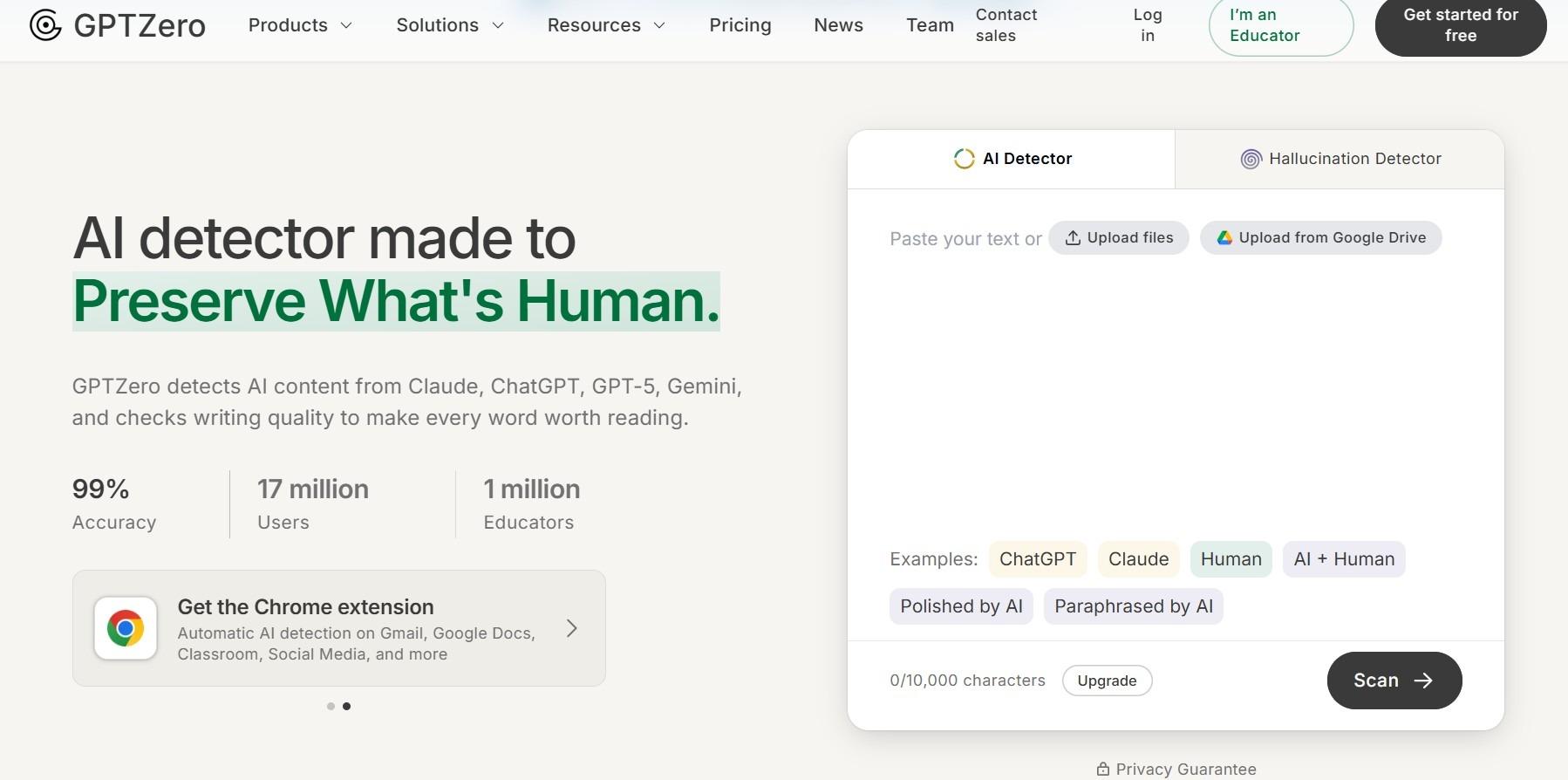
From our perspective, GPTZero remains one of the most recognizable AI detection tools, particularly in education. It offers a free tier covering up to 10,000 words per month, making it accessible for students, teachers, and occasional users. In June 2026, the company was acquired by Superhuman, highlighting how valuable AI-authenticity tools have become beyond the classroom.
During our testing, we found GPTZero performs best on fully AI-generated text with minimal editing. However, accuracy declined once we introduced human revisions into the editing process. Even relatively small changes to sentence structure, transitions, and wording noticeably reduced detection confidence.
That didn’t surprise us. GPTZero relies heavily on statistical patterns commonly found in AI-generated writing, so every meaningful human edit makes those patterns less consistent and, therefore, harder to detect.
Independent testing paints a similar picture. One 200-sample evaluation reported an 83% detection rate, alongside an 11% false-positive rate. That’s respectable, but it also means real human writing can still be flagged. Futurism’s testing raised another concern, estimating that one in five innocent students could be falsely accused under real-world conditions.
In our testing, we found GPTZero most useful as an early screening tool, not a final decision-maker. If it returned a high AI score, we’d dig deeper by checking other detectors, reviewing the writing style, and looking for evidence of original thinking before reaching any conclusion. That extra step consistently produced more reliable assessments than relying on GPTZero’s score alone.
We also think it’s important to set realistic expectations. GPTZero is good at identifying obvious AI output, but it’s far less reliable when evaluating edited drafts or collaborative writing where humans and AI have both contributed to the final piece.
2. Turnitin
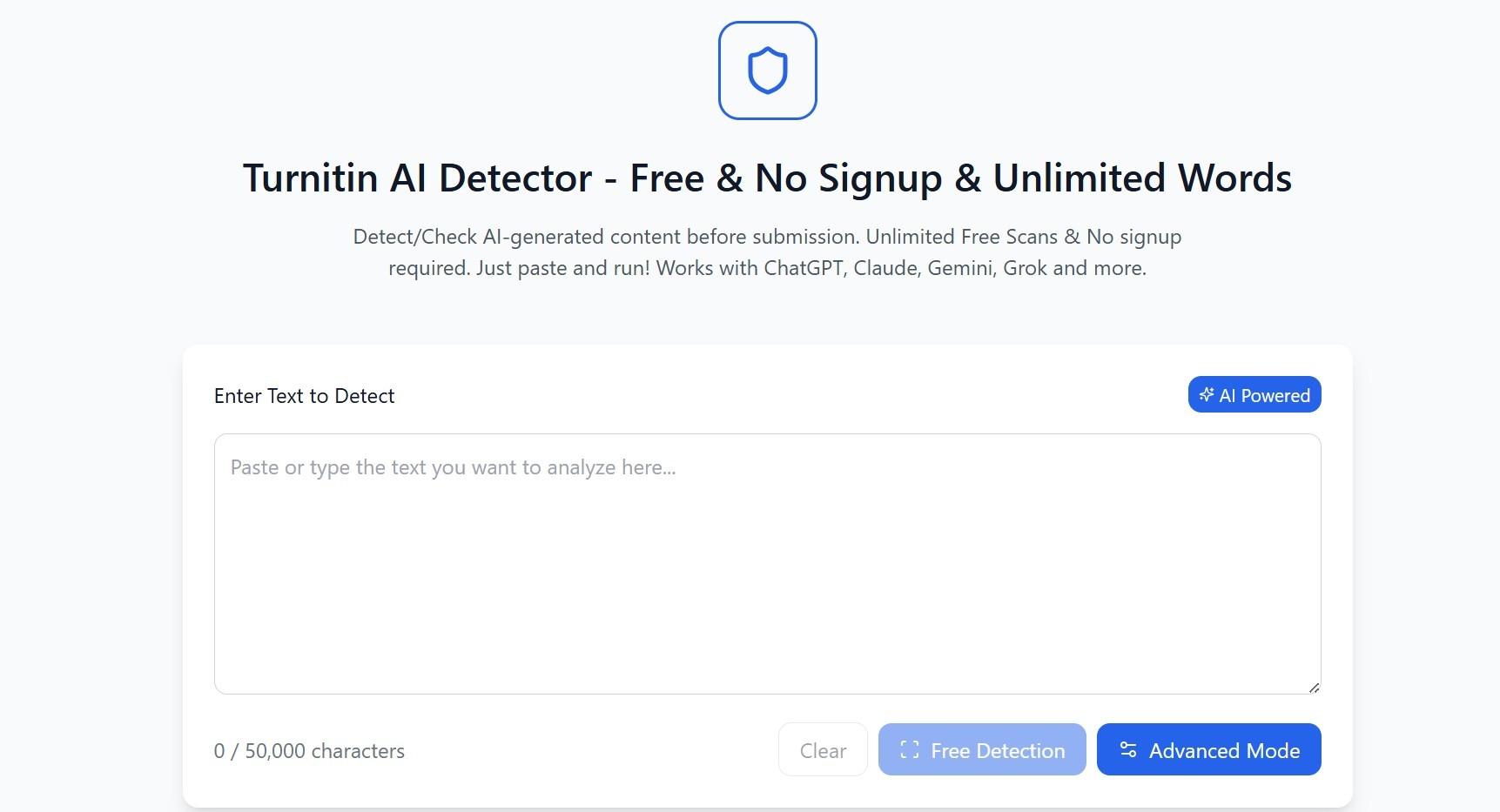
We wouldn’t recommend thinking of Turnitin as just another AI detector because it was built specifically for academic integrity. During our testing, we found that it’s also the least accessible platform on this list. You can’t simply sign up and upload a document. Access is available only through schools, colleges, and universities that license the software.
Its adoption is substantial. Around 40% of four-year colleges in the United States now use Turnitin’s AI-writing detection. The number of submissions flagged by the tool as more than 80% AI-generated has risen from roughly 3% in 2023 to about 15% by late 2025. That alone shows how quickly AI-assisted writing process workflows have become part of academic work.
From what we saw, Turnitin performs well when evaluating completely AI-generated text. One comparative study found it correctly identified 9 out of 10 pure AI samples. The picture became much less clear once human editing entered the workflow. The same evaluation produced three false positives out of ten human-written academic papers, while its detection rate dropped to 3 out of 10 after AI-generated text created by a model had been substantially rewritten by a person.
That mirrors what we found throughout this guide. Very little writing today is entirely human or entirely AI. Most people use AI to brainstorm, organize ideas, or draft sections before revising them extensively. That hybrid approach remains one of the biggest challenges for every AI content detector we’ve tested.
We also think that’s where Turnitin is sometimes misunderstood. The platform wasn’t designed to issue a final verdict on authorship. It’s meant to help educators identify work that deserves a closer look. A high AI score should prompt a conversation, not an automatic accusation.
3. Copyleaks
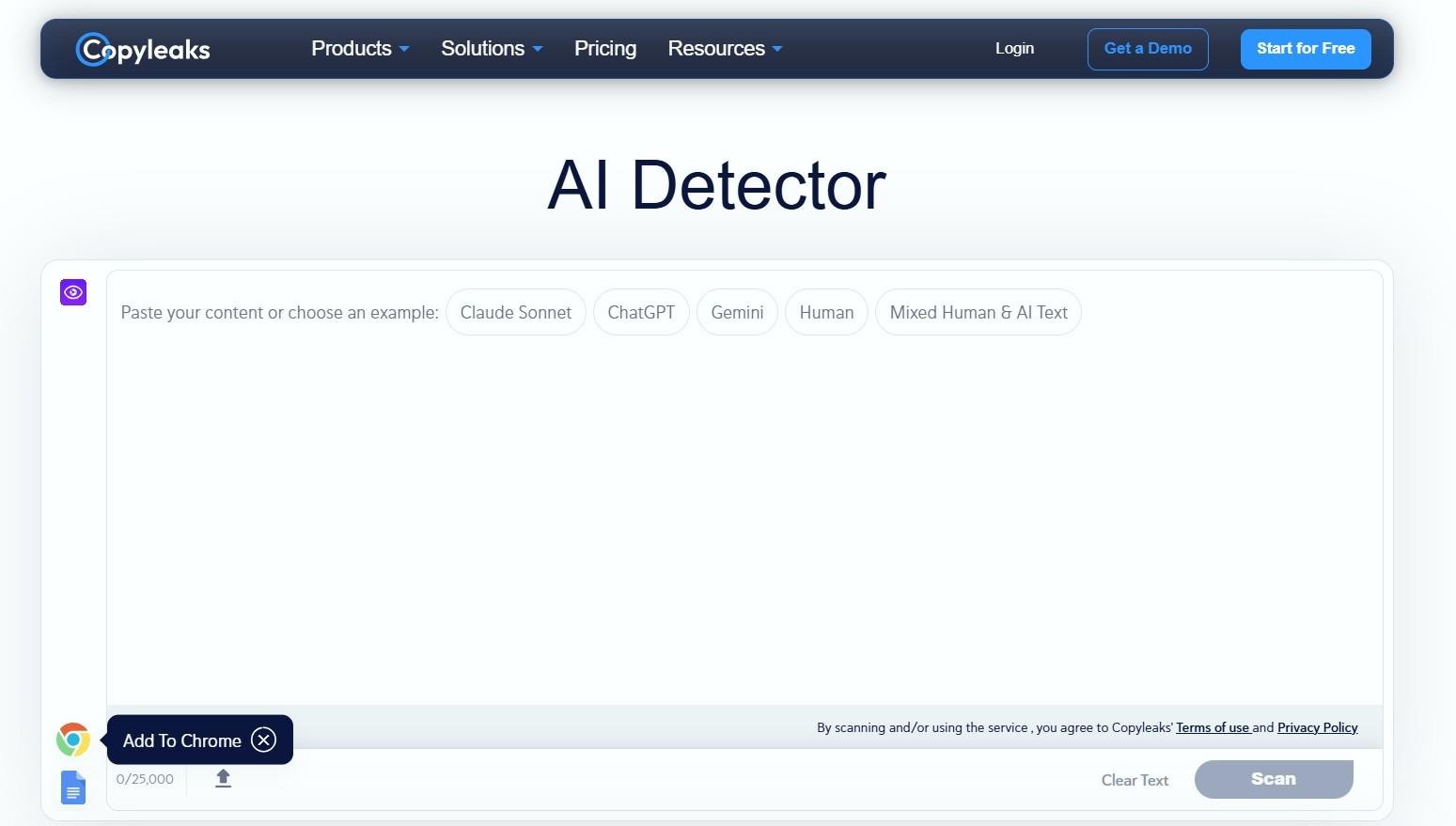
Unlike all other AI detection tools we tested, Copyleaks gave us the most confidence when reviewing real-world writing, not just untouched ChatGPT outputs. That’s an important distinction because most content today sits somewhere in the middle. A writer may use AI to generate a rough draft, then spend an hour rewriting, fact-checking, and adding their own voice and insights. That’s the kind of content many detectors struggle with.
What stood out to us wasn’t that Copyleaks caught the most AI text. It was how rarely it jumped to conclusions. During our testing, we found it consistently took a more measured approach, especially when evaluating polished human writing.
That matters because a detector that flags everything as AI isn’t necessarily more accurate. In many situations, it’s simply creating more work by forcing reviewers to investigate false alarms. We’d much rather use a tool that’s slightly more cautious than one that confidently accuses honest writers.
Independent testing reflects that. In one comparative evaluation, Copyleaks correctly identified 8 out of 10 AI-generated samples while producing just one false positive on real human writing. That’s one of the better trade-offs we’ve seen among today’s leading detectors.
It also performed particularly well on edited or “humanized” AI content, which is becoming far more common than raw AI output. One study reported an 85% detection rate, outperforming Turnitin (80%) and GPTZero (70%) in that specific scenario. We think that’s where Copyleaks has its biggest advantage. It isn’t just looking for obvious AI fingerprints. It does a better job of detecting AI generated content that’s been substantially revised after being generated.
Even so, we wouldn’t rely on Copyleaks alone. Use its findings alongside another detector and your own judgment. That’s still the most reliable way to assess whether a piece of writing is undoubtedly AI-generated.
4. Originality.ai
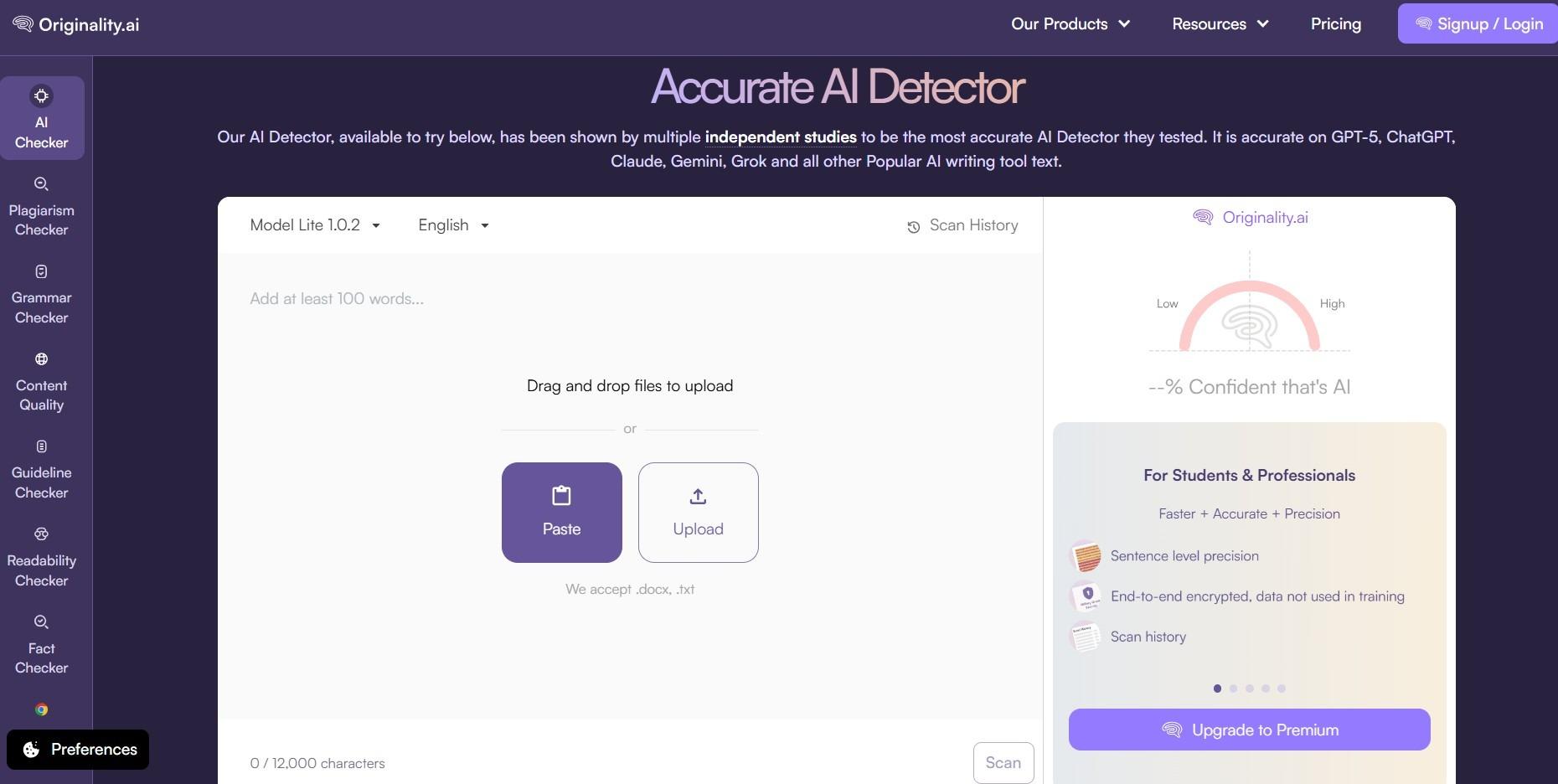
After testing Originality.ai alongside GPTZero, Turnitin, and Copyleaks, we quickly understood why so many SEO teams and publishers rely on it. The AI detector tends to look past obvious AI buzzwords and pay closer attention to the overall writing pattern.
Like most modern detectors, it analyzes signals such as perplexity (how predictable the wording is) and burstiness (how much sentence length and complexity vary). You don’t need to understand the mathematics behind those metrics to use the tool, but they help explain why a heavily edited article often receives a much lower AI score than the original draft.
We also found that Originality.ai was generally more dependable on polished web content than many free AI detector platforms we tried. Once we started adding original examples, restructuring paragraphs, and rewriting sections ourselves, the confidence scores dropped noticeably. That wasn’t surprising because real human editing changes the rhythm and predictability of the writing, which is exactly what these models are designed to measure based on their training data.
Where Originality.ai stood out for us was during the editing process. We’d often run an article before editing, make substantial revisions, then scan it again to see how the score changed. That workflow revealed something interesting: the biggest improvements didn’t come from replacing so-called “AI words.” They came from adding firsthand experience and original analysis that made the content more useful.
In our experience, that’s also how the best content gets created. Originality.ai is at its strongest when you use it to improve a copywriting draft, not to pass or fail one. For publishers and SEO teams reviewing written content at scale, that makes it a valuable quality-control tool, even though we’d still pair it with manual editing and fact-checking before making any final decision.
The False Positive Problem: Why You Shouldn’t Trust One Score
During our research, we found that many discussions about AI detection focus almost entirely on accuracy rates while overlooking something equally important: false positives. Even the best AI detector can wrongly accuse real people, and the consequences can be serious in schools, universities, workplaces, and even legal disputes.
Researchers from Stanford HAI, led by Weixin Liang, Mert Yuksekgonul, Yining Mao, Eric Wu, and James Zou, evaluated seven major AI detectors using essays written by non-native English speakers for the TOEFL exam. The results were eye-opening. On average, the detectors incorrectly classified 61.22% of the essays as AI-generated, and 89 of the 91 essays were flagged as AI by at least one detection tool.
The researchers discovered that many detectors associated simpler vocabulary and more predictable sentence structure with AI writing, even though those characteristics are common among people writing in a second language.
What happened next made the findings even more interesting.
When the researchers increased the linguistic variety of those same essays by improving vocabulary and sentence diversity, the false-positive rate fell from 61.22% to just 11.77%.
Think about what that means. Making authentic human writing better actually made detectors more likely to recognize it as human.
We also came across a real-world example that highlights why blind trust in detector scores can be dangerous. A PhD student reported that the introduction to her thesis, a section she had spent four months writing herself, was flagged as 67% AI-generated by her university’s detection system. The work was entirely original, yet the software suggested otherwise.
From our perspective, cases like these reinforce why you should always treat detector scores as probability signals, not evidence of misconduct. Even the most accurate AI detector can make mistakes, so the results should always be combined with manual review and contextual evaluation.
The Humanizer Arms Race
AI detection has become a moving target because detectors aren’t evolving in isolation. Every improvement they make is quickly met by another wave of AI tools designed to bypass them. That’s created what we see as an ongoing arms race driven by rapidly evolving AI technologies.
Today, dozens of online services promise to “humanize” AI-generated text by rewriting vocabulary, varying sentence length, introducing contractions, and breaking predictable writing patterns. Some websites even sell AI detection and AI humanization side by side, which creates an obvious conflict of interest. On one page, they tell you your content looks artificial. Next, they offer to fix it for a subscription fee.
During our research, we found a practical example that illustrates how closely detector scores and writing style are connected. We took a ChatGPT-generated article that GPTZero rated 94% AI-generated. After removing common AI vocabulary, rewriting vague phrases, and varying the sentence structure in a single editing pass, the score dropped to 62% without changing the underlying information.
That doesn’t prove detectors are broken. It shows they evaluate statistical writing patterns, many of which can be changed through thoughtful editing. This is also why we don’t recommend trying to “beat” AI detectors. If your goal is simply to lower a score, you’ll probably spend more time gaming the system than improving the writing itself.
A better approach is to make the content stronger. Add firsthand experience. Explain concepts in your own words. Include examples, opinions, or observations that come from real expertise. Those improvements naturally make writing feel more authentic because they reflect how people actually communicate.
In our experience, the best human writing doesn’t read differently because someone removed a handful of AI words. It feels different because it contains perspective, judgment, and experience that no detector can measure with a percentage alone. That’s also the most responsible way to use AI responsibly while still producing valuable content.
Does Google Penalize AI-Written Content?
No. Google doesn’t penalize content simply because it was written by AI. If you use AI to research a topic, organize your ideas, or polish your grammar before adding your own expertise, Google doesn’t automatically view that as low-quality content. Google’s public stance has consistently focused on helpfulness, originality, and E-E-A-T (Experience, Expertise, Authoritativeness, and Trustworthiness), regardless of how the content was produced.
We didn’t want to rely solely on Google’s own statements, so we also looked at what happens in the real world. According to research by Ahrefs analyzing more than 331k webpages, AI-assisted content can rank extremely well in Google Search.
The study found that 5.3% of pages ranking in positions 1–3 were entirely AI-generated, and every position in Google’s top 10 included a meaningful share of pages with at least 80% AI-generated content. The findings don’t support the idea of a blanket penalty for AI-assisted writing.
Does that mean every AI-written article performs well? Far from it.
From our research, we noticed that low-performing AI content usually shares the same weaknesses. It repeats information that’s already widely available, relies on generic explanations, lacks original insights, and often skips the depth needed to satisfy search intent. Those are quality problems first. AI simply makes them easier to produce at scale.
We’ve seen the opposite happen, too. When AI is used to speed up research or drafting, then strengthened with firsthand experience, expert analysis, original examples, and careful fact-checking, the finished article is often indistinguishable from one written entirely by a human. Our advice is to use AI to improve your workflow, not as a substitute for expertise. The content that performs best is the content that gives readers something they can’t easily find elsewhere, whether AI helped write the first draft or not.
Final Verdict
AI-generated content has become good enough that you can’t reliably identify it by reading a few sentences or running it through a single detector. After testing today’s leading tools and reviewing the latest research, we found that the most dependable approach combines technology with human judgment.
No detector consistently gets every decision right. GPTZero, Turnitin, Copyleaks, and Originality.ai each have strengths, but they also produce false positives and can disagree on the same piece of writing.
That’s why we’d never recommend relying on one score alone. Comparing results across multiple tools, then examining the writing itself for recurring vocabulary patterns, structural tells, factual accuracy, and signs of real expertise, gives you a far more reliable assessment than any percentage score on its own.
Our advice is to focus less on finding a single “got you” clue and more on building a case from multiple pieces of evidence. That’s the approach we found to be the most accurate during our testing, and it’s also the fairest. A detector score should start your investigation, not end it.
FAQs
How do I prove I didn’t use AI?
There isn’t a universal way to prove you didn’t use AI, but you can provide evidence that supports your work. Keeping version history in tools like Google Docs or Microsoft Word, saving research notes, outlining your drafting process, and retaining earlier revisions can demonstrate how the document evolved over time.
How to trick an AI content detector?
There’s no reliable or ethical way to “trick” an AI detector. If you’re using AI as a writing assistant, the better approach is to fact-check the output, add your own analysis, examples, and expertise, and ensure the final work reflects your understanding.
How to 100% humanize AI text?
No tool can guarantee that AI-generated text will appear 100% human to every detector. Different detection systems analyze different signals, so a document that passes one platform may still be flagged by another. To make AI-assisted writing sound natural, add firsthand experience and verify every factual claim before publishing.
Which AI text detector is the most accurate?
In our research, Copyleaks produced fewer false positives, GPTZero worked well on untouched AI text, Originality.ai performed strongly for web content, and Turnitin remained widely used in education. Each tool has strengths and limitations, which is why we recommend comparing results from multiple detectors instead of trusting one alone.