
Romania—rapidly emerging as Eastern Europe’s new defense battleground—has seen South Korean defense contractors launch an export offensive centered on cutting-edge unmanned technology. Key players in South Korea’s defense industry have come out in full force to gain an early foothold in a Romanian market that is pouring staggering budgets into unmanned ground forces following the Russia-Ukraine war.
BSDA 2026, the largest defense exhibition in Eastern Europe, kicked off on the 13th (local time) for a three-day run in the Romanian capital, Bucharest, drawing over 550 companies from 36 countries. The event, directly sponsored by the Romanian Ministry of National Defence, is the biggest of its kind in the Balkan region. South Korean firms—including Hanwha Aerospace, Hyundai Rotem, Hanwha Systems, LIG Nex1, and Kia—attended in large numbers to demonstrate the technological prowess of ‘K-Defense.’
The defining theme of this year’s exhibition was unmistakably ‘unmanned systems.’ As the nation responsible for NATO’s eastern flank, Romania is pursuing the largest unmanned ground forces project in Eastern Europe, spurred by the war in Ukraine. According to industry sources, Romanian military authorities are reviewing a long-term program to acquire at least 1,000 unmanned ground platforms for reconnaissance, logistics, medical evacuation, and fire support missions.
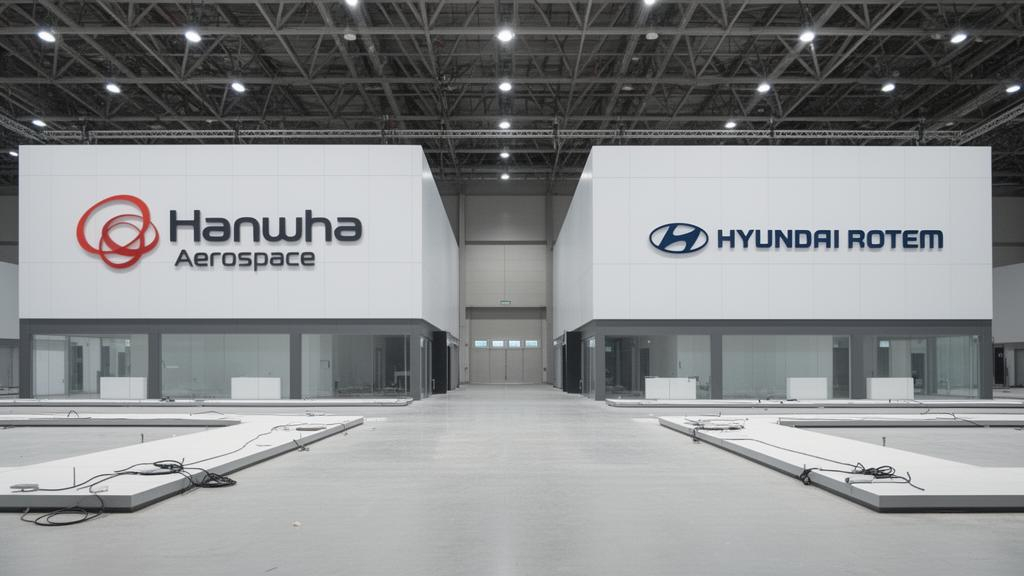
Targeting this massive demand, Hanwha Aerospace and Hyundai Rotem—already locked in intense competition over a multi-role unmanned vehicle program back in South Korea—went head-to-head once again on Romanian soil.
At the exhibition, Hanwha Aerospace highlighted its multi-role unmanned vehicle ‘Arion-SMET,’ its upgraded variant ‘GRUNT,’ and the tracked unmanned vehicle ‘THeMIS-K,’ developed in collaboration with Estonian defense firm Milrem Robotics. On the 12th, the day before the exhibition opened, the company staged a Manned-Unmanned Teaming (MUM-T) demonstration using the GRUNT and THeMIS-K for Romanian military officials, emphasizing reconnaissance and logistics capabilities. A company representative said the demonstration “drew significant interest from local officials.”
Hyundai Rotem showcased an extensive unmanned systems portfolio, with its military logistics multi-role unmanned vehicle ‘HR-Sherpa’ at the center. At its outdoor booth, the company simulated realistic operational scenarios, demonstrating the HR-Sherpa’s counter-drone defense operations, joint reconnaissance and fire support missions alongside a multi-legged walking robot, and the capabilities of a civilian unmanned firefighting robot, highlighting the scalability of its unmanned systems.
The competition between the two firms drew particular attention because of their long-standing, sharp rivalry over the same project at home. The multi-role unmanned vehicle program—a core element of the South Korean Army’s ‘Army Tiger 4.0’ future force modernization initiative—carries a total budget of 49.6 billion won (approximately $33.3 million). However, the program has been delayed for over a year due to conflicts over performance evaluation criteria and procedures. Hyundai Rotem raised fairness concerns, insisting that evaluation should be based on actual performance under identical test conditions rather than proposal figures measured in different environments. Hanwha Aerospace countered this claim by unilaterally completing a performance verification assessment in March.
The program regained momentum in April after Hyundai Rotem decided to participate in the performance verification evaluation. An official from South Korea’s Defense Acquisition Program Administration (DAPA) stated, “We plan to conduct the bid opening process as early as late May or early June to select the final contractor.” Industry observers believe the winner of this contract will also secure the upper hand in follow-on programs expected to be worth trillions of won.
Against this backdrop, the two companies’ parallel display of unmanned vehicle capabilities in Romania is being interpreted as more than mere export marketing. It is seen as a strategic move to prove technological competitiveness on the global stage first and seize dominance in future overseas export markets. The exhibition site was visited not only by Romanian military officials but also by representatives from South Korea’s Ministry of National Defense and DAPA, giving the event the character of an ‘unmanned systems competition showcase’ effectively aimed at both domestic and international audiences.
“Unmanned systems are the battlefield trend that has gained the most prominence since the Ukraine war,” an industry insider analyzed. “Competition for domestic programs is naturally extending into competition in overseas markets.”
Meanwhile, reflecting Romania’s geopolitical position bordering the Black Sea, interest in maritime unmanned systems was also strong. LIG Nex1 presented its ‘Haegum’ series of unmanned surface vessels and autonomous underwater vehicles. Hanwha Systems responded to maritime security demands by exhibiting an AI-based ‘Smart Battleship’ and a next-generation mine disposal system that uses autonomous navigation to detect and eliminate mines via self-detonation.
LIG Nex1 also actively marketed its air defense network to NATO member states in Romania. Building on the successful export of its ‘Shingung’ man-portable air defense system to Romania in 2023, the company heavily promoted its air defense systems this time, including ‘Haegung’ and ‘Cheongung-II.’ The Cheongung-II, in particular, has proven its combat capabilities in Middle East conflicts, and expectations are high for strong interest from NATO countries.
Kia, participating in BSDA for the first time this year, grabbed attention by unveiling the ‘Tasman Military Command Vehicle’ for the first time in Europe. Featuring the off-road capabilities characteristic of a pickup truck and equipped with specialized gear such as radio systems and light control devices, the vehicle has been serving as the standard command vehicle for South Korea’s military since last year. Alongside it, Kia also displayed a two-seat cargo variant of its Small Tactical Vehicle (KLTV). This new model features a snorkel with a raised air intake to prevent flooding and an enhanced engine cooling system, enabling all-weather operation in extreme environments ranging from deserts and mountains to tropical rainforests.
BSDA 2026 reaffirmed its status as an arena where global defense giants compete fiercely to capture the Romanian market, where demand for tanks, air defense systems, and unmanned platforms is surging amid Europe’s rearmament drive. Building on its success in Poland, K-Defense is now aggressively marketing Romania as its next strategic hub for penetrating the European market.