
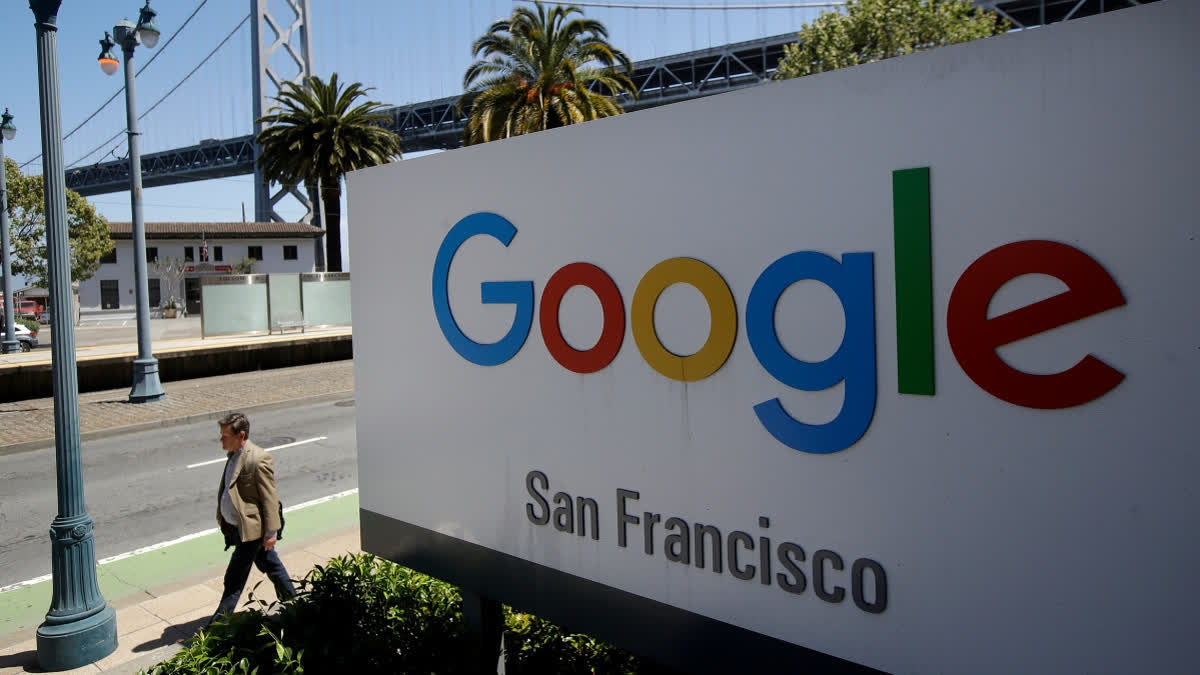
FILE – In this May 1, 2019, file photo a man walks past a Google sign outside with a span of the Bay Bridge at rear in San Francisco. (Image Credit: AP)
Students using Google software in the classroom will not be allowed to access the company’s search engine unless their school system also opts in to using artificial intelligence, the tech giant said Tuesday.
The Mountain View, California, company has been facing pushback from educators, child development experts and parents over the use of its technology in schools, with the backlash heating up since it announced in August that it had turned on its Gemini chatbot for many K-12 students who use Google Classroom.
On Tuesday, the company said that practice would no longer be the default option for school administrators. Instead, K-12 schools will be able to individually turn each Google tool on or off — including Gemini, Gemini Notebook and search, with each being off by default until administrators turn it on. But because search is integrated with AI, schools that opt out of AI altogether would also lose access to Google search.
We want to clarify what we announced today about our education services. Today’s announcements give schools more choice, not less. Here’s what we announced: – Gemini, Gemini Notebook, and Search will be OFF 🔴 by default. This is based on K-12 schools asking for more control over student use of AI services. – Schools are in control: They can choose to turn ON 🟢 one, two, or all of these services individually. – We are also updating Search for schools to make it better for learning. Specifically, AI Mode and AI Overviews will offer step-by-step guided learning through problems, so that students don’t get quick answers to schoolwork. We know there’s concern about students using AI to shortcut schoolwork, and schools have told us they want control. That’s exactly why we are making these changes today to address the feedback we’ve heard from educators in recent months. And we’ll continue to engage deeply with educators to ensure we are giving schools more choice, more controls, and improved Search for learning.
— News from Google (@NewsFromGoogle) November 3, 2026
“We believe schools should have control over AI in their classrooms and in providing administrators with controls to help them manage their approach,” Chris Phillips, Google’s vice president and general manager of education, said in a blog post.
The company also said it is updating its search tools to make them “better for learning,” including offering step-by-step guided learning through problems, so that students don’t get quick answers to schoolwork.
But turning off AI altogether is not possible if schools want to use Google products.
Google is by far the dominant provider of education technology for U.S. schools. Worldwide, the company says 150 million students and teachers use its Google Classroom platform, and many students use school-provided Chromebook computers.
Google faced an outcry in August when it switched on its Gemini chatbot for many K-12 students. Until August, Google had only allowed Gemini to be turned on for students 18 or older.
Tuesday’s announcement was met with swift criticism from educators and policymakers.
“Google is using its search monopoly to coerce schools into adopting AI. This highlights the danger of allowing an unregulated monopolist to control an essential service,” wrote Lina Khan, former chair of the Federal Trade Commission, on social media. “As the public increasingly pushes back against the use of AI in schools, Google is making clear it will punish those who don’t fall in line.”
New York City and Los Angeles, home to the nation’s biggest school districts, have issued temporary bans on generative AI tools in elementary and middle schools as they assess AI use and safety and develop policies on its use.
Many students already use AI to help with school and homework, but the technology has also made it easier to cheat and find quick, easy answers to questions instead of thinking critically. And experts have raised questions about how access to AI is affecting children’s brain development.
Google is using its search monopoly to coerce schools into adopting AI. This highlights the danger of allowing an unregulated monopolist to control an essential service. Multiple courts have found Google liable for violating antitrust laws, and this latest move shows it remains unchastened. As the public increasingly pushes back against the use of AI in schools, Google is making clear it will punish those who don’t fall in line.
— Lina Khan (@linamkhan) November 3, 2026
Josh Golin, executive director of children’s advocacy group Fairplay, said Google’s attempt to “strong-arm schools into using its AI products is likely to backfire.” He said Google’s technology in schools is not about learning but about “developing lifetime brand loyalty” for its products.
“Because AI isn’t safe for kids and undermines education and critical thinking, schools should turn off Google’s AI tools the minute that option becomes available,” Golin said in a statement.
Rather than fret about losing access to search, Golin urged schools to turn off not just AI but also Google, and “use this opportunity to help students find more privacy-protective alternatives for search, as well as ways to do more substantive research beyond search and click.”